

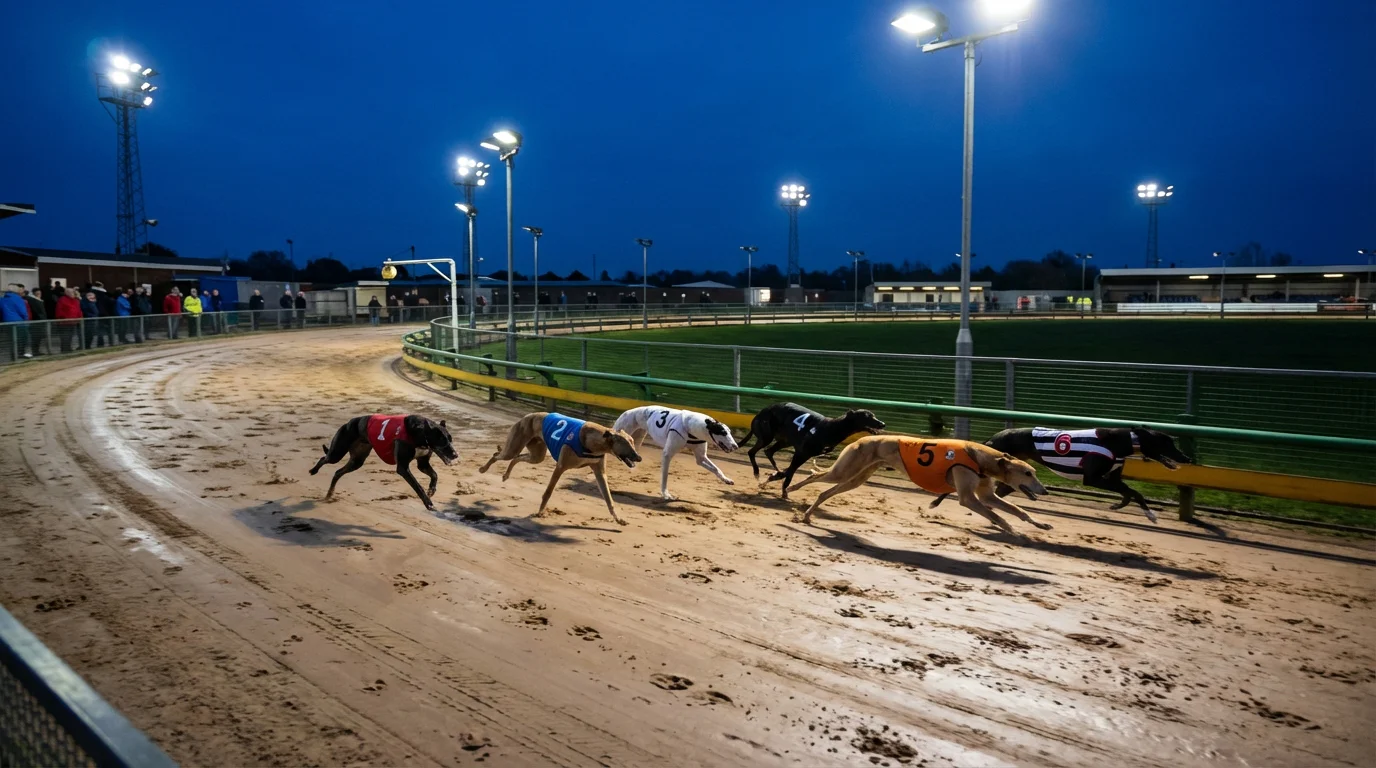
What UK Greyhound Racing Cards Actually Tell You
Six dogs. One card. Every number means something — if you know where to look. A UK greyhound racecard is not a menu; it is a compressed data file. Six names stacked vertically, each carrying a wall of abbreviations, split times, finishing positions, trap assignments, weight readings, trainer codes and calculated times that, on first glance, look like a language you never studied. For anyone coming from horse racing, or arriving fresh from a Saturday accumulator on the football, the greyhound card format is a specific kind of overwhelming.
The UK format is its own beast. It is built around the Greyhound Board of Great Britain (GBGB) system — metric distances on oval sand tracks, six-runner fields, a grading structure that runs from open class down through A-grade bands to maiden and sprint categories. None of this maps cleanly onto the American or Australian models, where field sizes, surfaces, and grading work differently. If you have read a US racecard and assumed you could scan a British one with the same mental template, you will have been caught out by the first column.
This guide is built for the reader who has looked at a UK greyhound racecard and felt some combination of curiosity and confusion. It walks through every element on the card — from the header block that frames the race, through the form lines that tell you what each dog has done, to the remark codes that explain why it happened. By the final section you will know how to translate those numbers into a reasoned bet, which is the only kind of bet worth placing. No tips. No predictions. Just the ability to read the same data the bookmakers read, and think for yourself.
A single UK greyhound racecard packs over 40 data points per runner into one page — trap, form figures, split times, bend positions, beaten distances, going adjustments, weight, trainer, breeding, career record and running remarks. Across six dogs, that is more than 240 individual data points per race.
Anatomy of a UK Greyhound Race Card
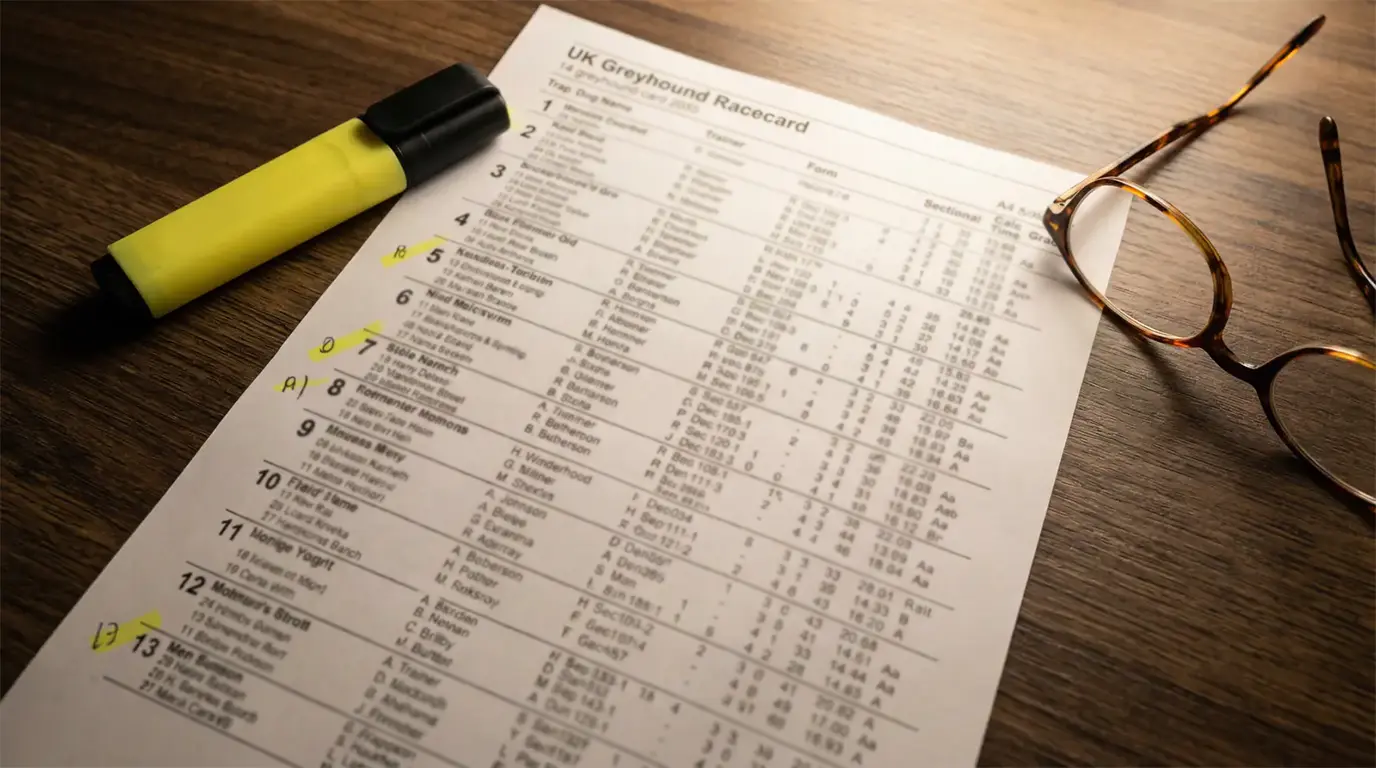
Before you read the form, read the frame. Every racecard begins with the same structural logic: a header block sets the context for the race, and individual runner blocks deliver the detail for each dog. Understanding the architecture means you never waste time deciphering what a number represents — you already know where to look for each piece of information.
Header Block: Date, Distance, Grade, and Prize Money
The header sits at the top of each race on the card. It tells you the meeting date, the race number within that meeting (a typical evening card runs 10 to 14 races), the distance in metres, and the grade. Distance is the first filter you should apply: sprints under 400 metres are two-bend affairs decided almost entirely by trap speed. Standard four-bend races over 460 to 500 metres demand a blend of pace and stamina. Stayer and marathon distances above 600 metres reward endurance and tactical positioning above everything else.
The grade appears as a code — A3, D2, OR, S1 — and it defines the class of competition. Grades are not decorative; they directly determine the field's ability level. An A3 race at Romford contains faster dogs than an A6 at the same track, and any form comparison that crosses grade boundaries without adjustment is unreliable. The header may also list prize money, which is more relevant for understanding the meeting's prestige than for betting purposes, and a British Greyhound Racing Fund (BGRF) indicator confirming the race falls under the regulated GBGB framework.
BGRF — British Greyhound Racing Fund. A non-statutory, not-for-profit body funded by voluntary contributions from bookmakers that supports welfare and integrity of licensed greyhound racing in Britain. A BGRF indicator on a race header confirms the race operates under full GBGB rules and regulatory oversight.
Runner Block: Name, Trap, Trainer, and Breeding
Below the header, each dog gets its own block. The trap number comes first — 1 through 6 — followed by the dog's name. On most cards the name is printed alongside the trainer's initials and the dog's colour, sex and breeding details (sire and dam). The whelping date tells you the dog's age; most competitive greyhounds are between two and five years old, and knowing where a dog sits in that window can flag whether it is still improving or approaching the tail end of its racing career.
Breeding data appears more often on detailed form databases than on basic racecard printouts, but when it is present it carries information. Certain sires produce dogs that favour sprint distances; others are associated with staying stamina. This is not horse racing, where pedigree analysis fills entire publications, but in a six-runner field even marginal insights have value. The trainer code matters as well — some kennels have exceptional records at specific tracks, and that data is available on the card if you know to look for it.
Career Record: Runs, Wins, and Places at a Glance
Most detailed racecards include a career summary: total starts, wins, and places, sometimes broken down by distance or track. This gives you a snapshot of consistency. A dog with 80 starts and 25 wins has been running profitably over a meaningful sample. A dog with 5 starts and 3 wins might be talented or might simply have raced in weak fields — the grade context determines which interpretation is correct.
Some cards also show track-specific stats. A dog with a 40 per cent win rate at Crayford but only 10 per cent at Nottingham is telling you something about track suitability that raw form figures alone might not reveal. When career stats are available, they offer a quick way to separate horses for courses — or, in this case, dogs for tracks.
Reading the Form Lines: Last Six Runs Decoded
The form lines are the dog's diary — but only if you read between the entries. Below each runner's name and career summary sits a block of data showing its most recent six races, listed with the most recent run at the top. Each line is a compressed record of one outing: date, track, distance, trap drawn, sectional time, bend positions, finishing position, beaten distance, the winner and second-place finisher, class, going, weight, starting price, calculated time and running remarks. That is a lot of information in one row, and the temptation is to skip to the finishing position and move on. Resist it. The finishing position is the least useful number on the line.
Column by Column: What Each Data Point Means
The date column tells you when the run took place. Recency matters — a form line from three weeks ago is more relevant than one from three months ago, though both may appear in the same six-run block. The track code identifies the venue: Rom for Romford, Cfd for Crayford, Not for Nottingham, and so on. Distance is listed in metres. Check whether the dog has been running over the same distance as today's race; a dog switching from 480m to 285m is changing its entire running profile.
The trap column shows which starting box the dog occupied. Compare this with today's draw — a dog that has been performing well from trap 1 but is now drawn in trap 5 faces a different tactical challenge. The sectional time (often labelled "sect" or "split") records the time from the traps to the first timing point, usually around the first bend. This is the earliest clue to a dog's pace and is one of the most useful numbers on the card, which is why it gets its own section later in this guide.
Bend positions describe where the dog was running at each bend — first bend, second bend, and so on. A notation like 2-2-1-1 means the dog was second at the first two bends and led from the third to the finish. Finishing position is self-explanatory but needs context: finishing fourth in an A2 race at a competitive track is a different result from finishing fourth in a D4. Beaten distance tells you how far behind the winner the dog finished, measured in lengths. The winner's name and second-place dog are listed so you can cross-reference their form if needed.
Class, going and weight appear at the end of each form line. Class confirms the grade at the time of the run. Going is expressed as a numerical adjustment: a positive number means the track was running fast, a negative number means it was slow, and N means normal. Weight is recorded in kilograms to one decimal place. The starting price (SP) is the odds the dog went off at, which gives you a historical read on how the market assessed its chances.
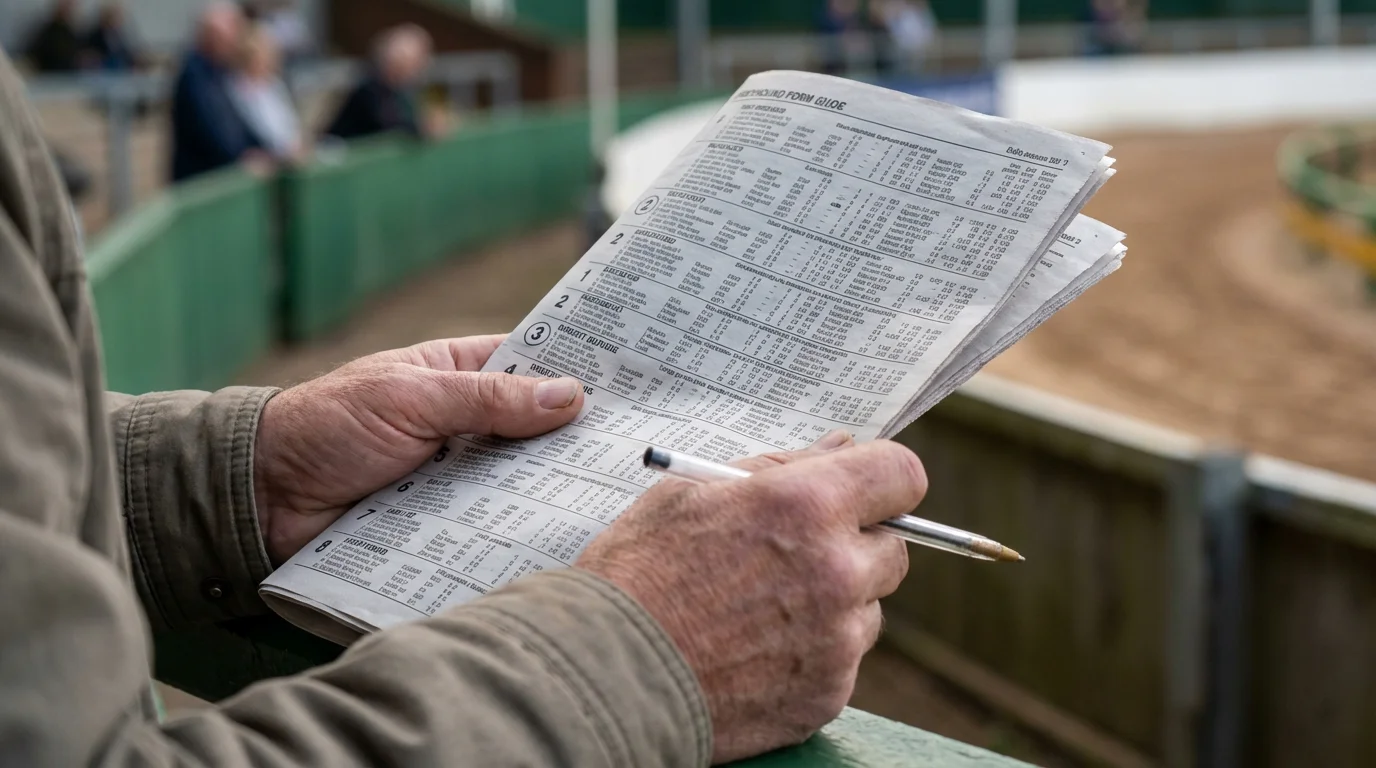
Spotting Patterns Across Six Runs
Individual form lines are data points. Patterns across six lines are intelligence. Look for consistency first. A dog finishing 1-2-1-2-1-3 in the same grade over the same distance is reliable. A dog showing 1-5-2-6-1-4 is inconsistent, and inconsistency in a six-runner field usually has an explanation — check whether the poor runs came from unfavourable trap draws, on going that did not suit, or at tracks where the dog has no record of performing.
Improving form is the most valuable pattern. A sequence like 5-4-3-2-2-1, read from oldest to newest, shows a dog getting faster or being better managed by its trainer. When improving form coincides with a grade drop — a dog moved from A4 to A6, for instance — you may be looking at a runner about to meet a field it can dominate. That is the kind of edge the racecard hands you for free.
Declining form is the mirror image. A dog that was winning in A3 and is now finishing fourth or fifth in A5 is either carrying an injury, ageing out of its peak, or struggling with conditions. The form line alone will not tell you which, but it will tell you to look harder before backing it.
Split Time
Run 1: 4.82s. Run 2: 4.95s. Run 3: 4.78s. Faster splits indicate sharper early pace.
Bend Position
Run 1: 1-1-1-1. Run 2: 3-2-1-1. Run 3: 1-1-1-1. Consistent front-running profile.
Finishing Position
Run 1: 1st. Run 2: 2nd (0.5L). Run 3: 1st. Reliable in-the-frame performer.
CalcTm
Run 1: 29.32. Run 2: 29.40. Run 3: 29.28. Narrow CalcTm range shows genuine consistency.
When Form Lies: Misleading Sequences
Form lies when you strip it of context. The most common trap is reading a sequence of poor finishes as evidence that a dog is out of form when, in reality, it has been meeting interference at every start. The remarks column — covered in detail later — is the antidote. A dog marked "Crd2 Bmp3" (crowded at the second bend, bumped at the third) that still managed third is running better than the number suggests.
Another trap: the grade hop. A dog showing 1-1-1 in D grade gets promoted to B grade and immediately finishes fifth. That is not bad form — it is a class test. Some dogs pass it after an adjustment run or two. Others do not. The form line shows the results; your job is to interpret the context.
Weight shifts can also obscure the picture. A bitch gaining 1.5kg over two runs may be coming into season rather than losing fitness. A dog losing 0.8kg after a break might be returning sharper or might be underprepared. Weight data is on the card, but it requires interpretation rather than reflex judgement.
Trap Numbers, Jacket Colours, and Draw Bias
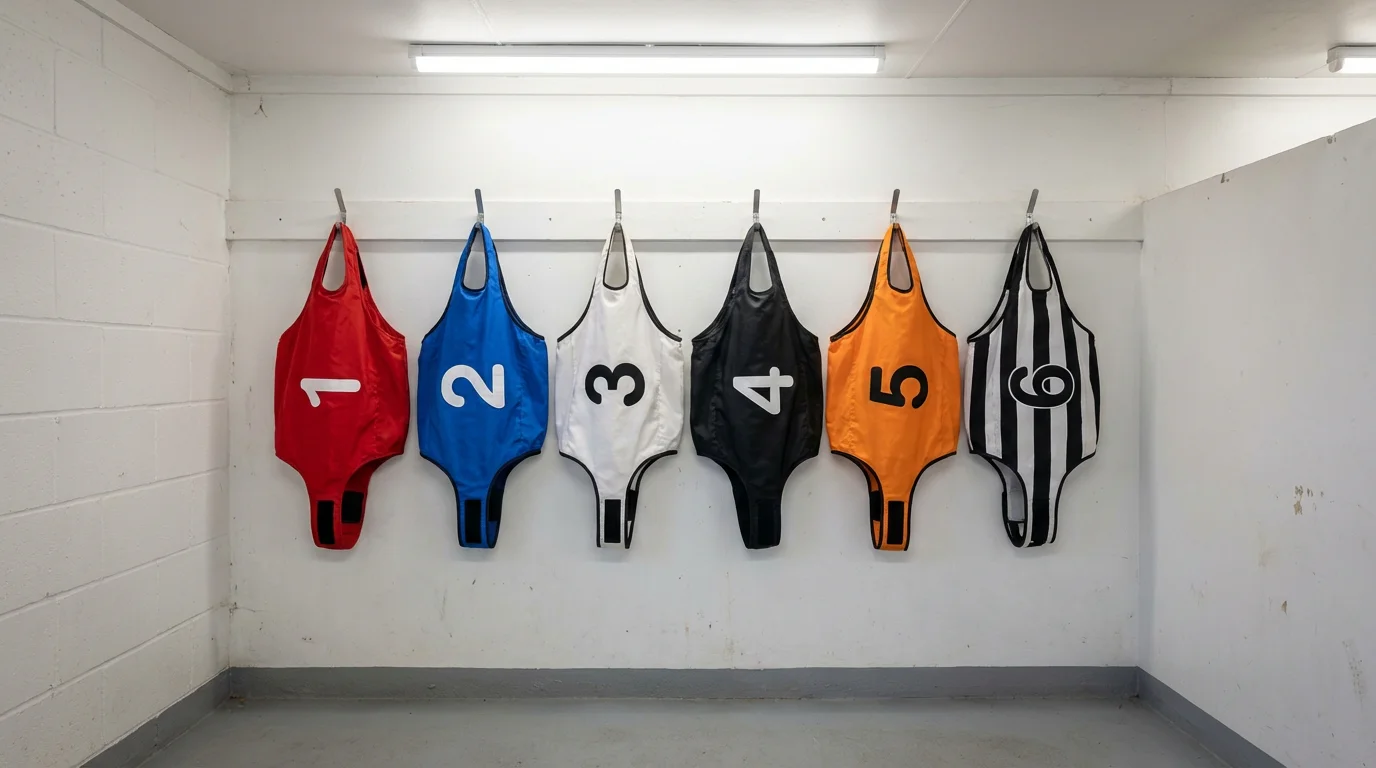
Trap 1 gets the red jacket — and a head start at tracks with a short run to the first bend. The six-trap system assigns each dog a numbered starting box and a corresponding jacket colour that stays the same across every GBGB-licensed track in Britain: red for trap 1, blue for trap 2, white for trap 3, black for trap 4, orange for trap 5, and black-and-white stripes for trap 6. Learn these once and you can follow any race from any angle, including on a grainy live stream at two in the afternoon.
Draw bias is not a myth — it is geometry. The dog in trap 1 has the shortest path to the first bend on every oval track. On tight circuits like Romford, where the run to the first turn is short and the bends are sharp, that advantage is substantial. Trap 1 win rates across UK greyhound racing sit around 18 to 20 per cent depending on the track, above the 16.7 per cent you would expect if all traps were equal. The inside rail is real estate, and the dog that gets there first usually keeps it.
The racecard tells you not just the trap number but the dog's running style. Wide runners carry a W designation and are drawn towards the outside — traps 5 and 6 — because their natural racing line takes them away from the rail. Railers run tight to the inside and are best served by low trap numbers. Middle runners sit between the two. When a railer gets drawn in trap 5 because the draw allocation does not match the field's distribution of styles, the card has just handed you a piece of information the market might not fully price in.
Track-specific trap statistics are published by most major form databases and are worth consulting before any meeting. A track where trap 6 has a higher-than-expected win rate — often the case at venues with long runs to the first bend and sweeping turns — tells you something about the circuit's geometry that applies to every race on the card.
Railer
Natural inside runner. Hugs the rail from break to finish.
Ideal traps: 1, 2. Acceptable: 3.
Form indicator: look for strong early split times and first-bend lead positions.
Risk: crowding if drawn outside natural line. Check remarks for "FcdW" (forced wide).
Wide Runner
Runs wide through the bends. Covers more ground but avoids traffic.
Ideal traps: 5, 6. Acceptable: 4.
Form indicator: look for strong finishing speed and ability to make up ground from behind.
Risk: too much ground to cover at tight tracks. Less effective in sprints.
Greyhound Race Grades and What They Mean for Betting
Grades are the ladder. Know where a dog stands on it — and which direction it is climbing. The UK grading system sorts greyhounds into classes based on demonstrated ability, primarily measured through finishing times and recent results. Standard and middle-distance races are graded A1 through A11, with A1 representing the highest level below open class. Sprint races carry a D prefix (D1, D2, and so on), stayer races use S, maiden races are labelled M, and open races — the elite tier, where the best dogs in training compete without grade restriction — are marked OR.
The grading system is managed track by track under GBGB oversight. A dog that wins consistently at A5 will be promoted to A4 or A3, facing faster opposition. A dog that finishes in the back half of the field repeatedly will be dropped to A6 or A7, meeting slower dogs. These movements are not punishment or reward — they are calibration. And for the bettor, they are signals.
A class rise is a warning flag. A dog stepping up from A5 to A3 is entering a faster race and may not have the raw speed to compete. Its recent form — all wins and places — was compiled against weaker fields. The grade change resets the competitive context, and the racecard tells you this explicitly if you look at the class column in the form lines.
A grade drop, on the other hand, is where opportunity lives. A dog dropping from A3 to A5 is not necessarily getting slower. It may have been unlucky in running, returning from a break, or adjusting to a new track. When it meets an A5 field, it may have a genuine class advantage that the finishing-position form does not fully reflect. Cross-referencing the grade drop with calculated times — covered in the next section — is one of the most reliable methods for identifying value on a racecard.
Hurdles racing (H grade) still exists at a small number of UK venues but is rare enough that most bettors will encounter it infrequently. The 2026 GBGB fixture calendar continues to schedule hurdles at selected meetings, though the majority of racing falls within the standard grading bands.
A greyhound dropping from A3 to A5 is not getting slower — it is being given a field it can beat. That is where value hides on the racecard.
Sectional Times, Winning Times, and Calculated Time
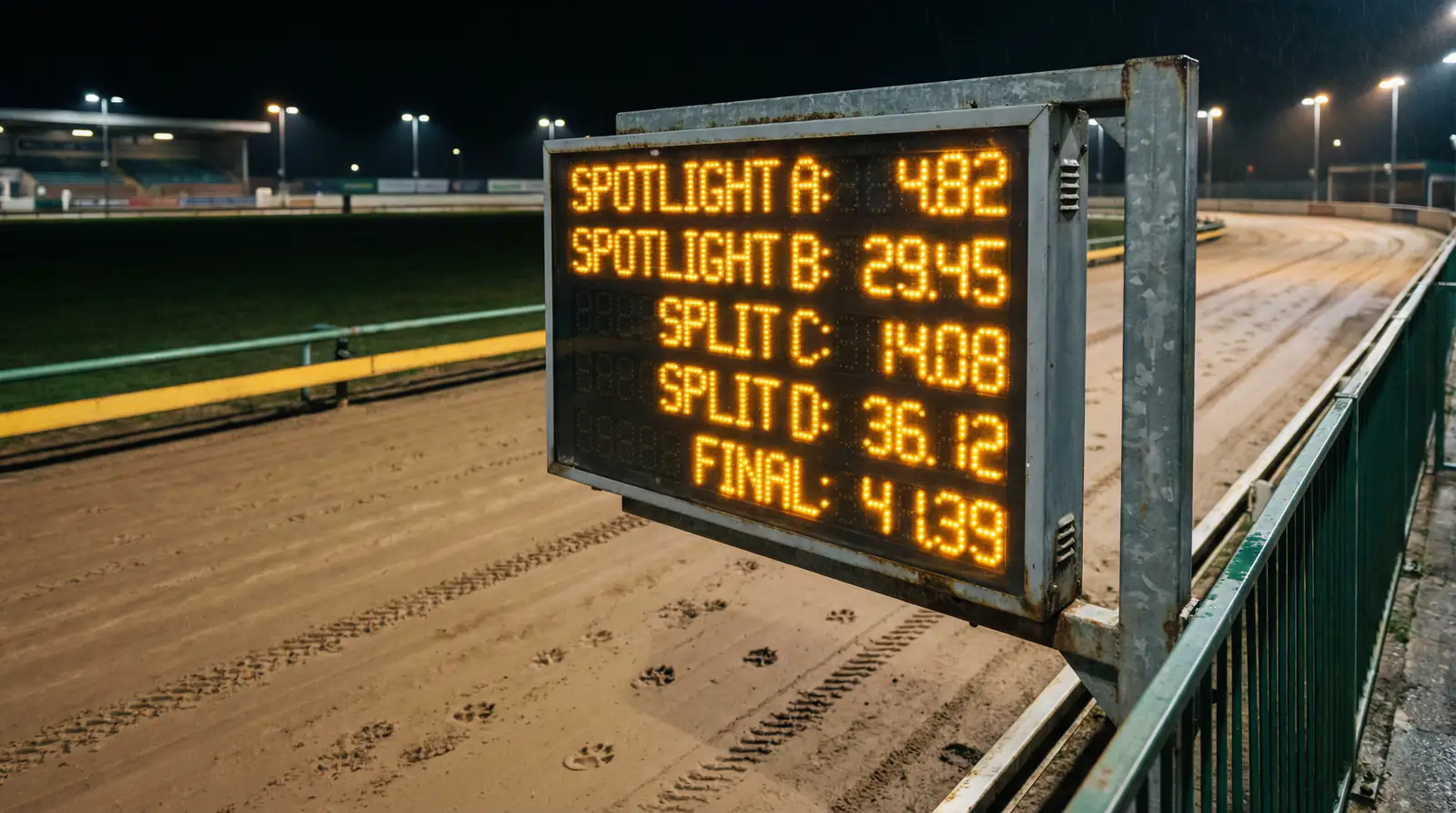
Raw time is a snapshot. Calculated time is the truth after the going has been accounted for. The time-related data on a greyhound racecard is the most analytically powerful information available to the bettor, but it is also the most frequently misread. Three distinct time metrics appear on most detailed UK racecards — sectional time (also called split time), winning time, and calculated time (CalcTm) — and confusing them leads to bad bets.
Split Time: The First Clue to Early Speed
The sectional time records how fast the dog reached the first timing point, which is usually positioned around the first bend. On a standard 480-metre race, the split covers roughly the first 150 to 200 metres from the traps. This is the single most predictive number for short and mid-distance races, because the dog that leads at the first bend wins more often than any other runner in the field.
Fast, consistent split times across multiple runs indicate a dog with genuine early pace — one that breaks well from the traps and gets to the rail before the traffic develops. Compare split times within the same race to identify the likely pace scenario: if two dogs have splits within 0.03 seconds of each other and are drawn in adjacent traps, there will be a battle for the first bend, and one of them is going to lose it. That contest creates interference risk for both dogs and potential value for a third dog running behind them in clear air.
Split times also vary by track. A 4.80-second split at Romford, where the run to the first bend is shorter, means something different from a 4.80 at Towcester, where the geometry gives dogs more room. Always compare splits within the same track context.
Calculated Time: The Only Time That Matters
Winning time is the raw clock time from traps opening to the first dog crossing the line. It is a fact, but it is not a fair comparison tool. Track conditions change between meetings and even between races on the same card. A 29.50-second run over 480 metres on a dry Tuesday is not equivalent to 29.50 on a rain-soaked Friday. The sand surface was different, and the time needs adjustment.
That adjustment is what calculated time (CalcTm) provides. CalcTm takes the raw time and modifies it for the going — the measured condition of the track surface at the time of the race. The going adjustment is expressed in hundredths of a second: a going of +10 means the track was running 0.10 seconds fast (i.e. favouring quicker times), so the CalcTm adds 0.10 to the raw time to normalise it. A going of -15 means the track was slow, so 0.15 is subtracted. Normal going (N or 0) means no adjustment.
CalcTm is the fairer comparison tool because it strips out environmental variance. Two dogs may have recorded raw times of 29.40 and 29.55 in different races, but if the first ran on +15 going and the second on -10, their calculated times are much closer: 29.55 and 29.45. The dog with the slower raw time was actually the faster runner on a like-for-like basis. This kind of reversal happens regularly, and punters who rely on raw times instead of CalcTm will consistently misjudge the field.
Some racecards mark a dog's best recent CalcTm with a star or asterisk. This is a useful shortcut for identifying the fastest dog on adjusted time, but it should not be your only filter — a single fast CalcTm might reflect a fluke run, while a dog with three CalcTms in a narrow range is more trustworthy.
Dog A — Ballymac Doris
CalcTm: 29.40 | Odds: 3/1
Implied probability: 25%. Fastest CalcTm in the field.
Dog B — Droopys Expert
CalcTm: 29.55 | Odds: 6/4
Implied probability: 40%. Favourite, but 0.15s slower on adjusted time.
The card data suggests Dog A offers better value at 3/1 than Dog B at 6/4 — the market is pricing Dog B's recent finishes without fully accounting for the going adjustment that inflated those times.
Racecard CalcTm Toolkit
Three tools built from the guide’s own going-adjustment maths and career-form logic.
Positive going means the track ran fast, so CalcTm adds time back to the raw figure; negative going means the track ran slow, so CalcTm subtracts. This is the same adjustment the guide describes: a raw 29.40 on +15 going and a raw 29.55 on -10 going both normalise to different CalcTms once you strip out conditions.
This mirrors the guide’s own worked example: the dog with the faster adjusted time isn’t always the market favourite. When a faster CalcTm dog is priced at a lower implied probability than a slower rival, the market may be underrating it.
A high win rate from a handful of starts can simply mean weak fields, not genuine class. The guide contrasts an 80-start, 25-win dog (a meaningful sample) with a 5-start, 3-win dog (too small to trust at face value) — this tool flags which bracket your dog falls into.
Decoding Racecard Remarks and Running Comments
Numbers tell you what happened. Remarks tell you why. The running remarks column on a greyhound racecard is the most underread section of the entire card, which is precisely why it offers the most edge to anyone willing to decode it. Every abbreviated comment describes an event during the race — how the dog started, where it ran, whether it encountered interference, and what its finishing effort looked like. Without these remarks, bare form figures can be deeply misleading.
Start-quality codes come first in the sequence. QAw means quick away — the dog broke cleanly from the traps. SAw means slow away, indicating a poor start that likely cost early position. EP signals early pace, confirming the dog was challenging for the lead from the off. These codes tell you whether the dog's finishing position was achieved from a favourable or unfavourable platform.
Running-position codes describe the dog's path through the race. Rls means rails — the dog ran along the inside rail. Mid is middle, W is wide. RlsTMid means the dog started on the rail and drifted to middle, which can indicate it was pushed off its preferred line by a rival. These matter because a dog that finished third while running wide covered more ground than one that finished third on the rail.
Interference codes are the most valuable for betting purposes. Crd means crowded — the dog was squeezed between runners. Bmp means bumped, a direct physical contact. Blk is baulked, meaning the dog's path was blocked by another runner. FcdW — forced wide — indicates the dog was pushed off its racing line. The number after the code tells you at which bend the incident occurred: Crd3 means crowded at the third bend, Bmp1 means bumped at the first.
Finishing-effort codes round out the picture. ALd means all led — the dog led from start to finish. EvCh is every chance, indicating the dog had a clear run and a fair opportunity but did not win. DrewClear means the dog pulled away from the field in the closing stages. NvDng — never dangerous — tells you the dog was outclassed or out of position throughout.
The skill is in combining these codes. A dog marked "SAw Bmp1 Crd2 RlsTMid" that still finished third was comprehensively disrupted and ran a better race than the bare form suggests. Next time out, from a clean break and a favourable trap, that dog is a genuine contender — and the market may not fully reflect it because most punters never read the remarks.
A dog marked "Crd3 Bmp4" that still finished second ran a better race than the bare form shows. Next time out, in a cleaner run, it is a serious contender.
From Card to Bet Slip: A Practical Walkthrough
You have read the card. Now make it pay. This section walks through the process of using racecard data to build a bet, step by step, using a hypothetical A3 race over 480 metres at a standard UK track with six runners. The goal is not to hand you a winner — it is to show you the reasoning that separates a considered bet from a coin flip.
Step 1: Filter by Calculated Time and Grade
Start with CalcTm. Pull each dog's last three calculated times and look for the fastest and most consistent. A dog with CalcTms of 29.32, 29.40 and 29.35 is both fast and reliable. A dog with 29.20, 29.80 and 29.45 is erratic — the 29.20 is exceptional but the range suggests it cannot be relied upon.
Now check the grade context. Were those CalcTms achieved in A3 races or in A5 races? A CalcTm of 29.40 in A3 means the dog ran that time against strong opposition. The same time in A5 means it ran against a slower field. If a dog is stepping up from A5 to A3 for the first time, its CalcTm might not translate against faster rivals — particularly if it relied on leading from the front and will now face dogs with equally sharp early speed.
Filter the six-runner field down to three or four dogs whose CalcTm data makes them competitive at this grade. The others — those with significantly slower times, inconsistent ranges, or CalcTms achieved at lower grades — are unlikely contenders unless the card shows a strong non-time-related angle, such as a favourable draw or a pattern of interference in recent runs.
Step 2: Cross-Reference Trap Draw and Running Style
Of your three or four shortlisted dogs, check each one's trap draw against its running style. A railer drawn in trap 1 or 2 is in its ideal position. A railer drawn in trap 5 faces a problem — it needs to cross traffic to reach the rail, and in a 480-metre race with a short run to the first bend, that crossing might not happen cleanly.
Look at the split times to identify the likely first-bend leader. If your fastest CalcTm dog also has the best recent split time and is drawn inside, the alignment is strong. If two fast breakers are drawn next to each other in traps 2 and 3, expect trouble at the first bend — and consider whether a wider-drawn dog with slightly slower splits might benefit from a cleaner run.
Read the remarks from each dog's last two or three runs. Has one of your contenders been consistently bumped or crowded? If so, is today's trap draw likely to produce the same problem, or does it offer a cleaner passage? A dog that has been unlucky in running but has the CalcTm to compete is a classic value candidate — the market often underrates it because the bare finishing positions look mediocre.
Step 3: Choose Your Market
The type of bet you place should match the strength of your read on the card. If one dog stands clearly above the rest on CalcTm, has a favourable draw, and is priced at 2/1 or longer, a straight win bet is appropriate. You have a clear opinion and the odds offer value against your assessment.
If two dogs are closely matched and you cannot separate them, a forecast bet — predicting first and second in the correct order, or a reverse forecast covering both permutations — lets you back your analysis without needing to pick a definitive winner. In a six-runner field, forecasts are statistically more viable than in horse racing because the smaller field reduces the number of possible outcomes.
Each way betting applies when you believe a dog will be competitive but may not win. In greyhound racing, each way pays on first and second only (not third), at a quarter of the win odds. The threshold for value on an each way bet is roughly 4/1 — below that price, the place portion of the return usually does not justify doubling the stake.
Pre-Bet Checklist
- Check CalcTm against the field — is your selection within the top two or three?
- Assess trap draw for this specific track — does the draw favour or hinder the dog's running style?
- Read remarks from the last two to three runs — has interference masked better form?
- Confirm grade direction — is the dog rising (harder), dropping (easier), or stable?
- Compare SP with your estimated chance — does the price offer value against the data?
Where to Find Today's UK Greyhound Racing Cards
The card is only as useful as the source it comes from. Not all racecard providers present the same depth of data, and knowing where to look for the level of detail you need saves time and improves the quality of your analysis.
Timeform is the most analytically rich option for serious punters. Their greyhound racecards include Timeform ratings, sectional times, calculated times, trap statistics and analyst commentary. The depth of form data is excellent, though some features sit behind a subscription. For bettors who treat greyhound racing as a serious analytical exercise, Timeform is the benchmark.
Sporting Life provides free racecards for all UK meetings with form figures, tips and odds comparisons. The interface is clean and the data is reliable, though it does not match Timeform for advanced metrics like CalcTm breakdowns. It is a strong starting point for punters who want comprehensive coverage without paying for it.
At The Races (now part of the Sky Sports Racing ecosystem) offers racecards with integrated video replays, which is useful for cross-referencing form remarks against actual race footage. The 2026 racing season continues to see At The Races provide free-to-access cards for most BAGS and evening meetings.
Individual track websites — Romford, Crayford, Towcester and others — publish their own cards for upcoming meetings. These tend to be basic printout formats with less analytical overlay, but they are the first place cards appear for track-specific fixtures and can be useful for confirming runner declarations and late withdrawals.
RPGTV and Sky Sports Racing broadcast live UK greyhound meetings and display racecards as part of their coverage. If you are watching racing live, the on-screen card is often the quickest reference, though it lacks the detail of a dedicated form database. For virtual greyhound racing, which uses randomly generated fields rather than real form, the card format is simplified and CalcTm analysis does not apply — virtual racing is a different product entirely.
Greyhound Bet Types at a Glance
The type of bet you place should match the strength of your read on the card. Greyhound racing offers a range of markets that scale with your confidence level and the depth of your racecard analysis, from the simplest single-selection wager through to exotic multiples that demand you predict the first three finishers in order.
A win bet is the foundation: back one dog to cross the line first. It suits situations where your card analysis has identified a clear standout — the fastest CalcTm, the best draw, the cleanest recent run. There is no hedging. If you are right, you collect; if you are wrong, you lose the stake.
A place bet backs a dog to finish in the top two. In greyhound racing's six-runner fields, place terms are tighter than in horse racing — typically first or second only. Each way combines a win bet and a place bet at equal stakes: if the dog wins, both pay; if it places, only the place portion returns. The place part pays at one quarter of the win odds.
A forecast asks you to name the first two finishers. A straight forecast requires the correct order; a reverse forecast covers both possible orders at double the stake. Forecast bets are where racecard analysis deepens — you need to read not just one dog's form but two, and assess how their running styles and draws interact. In a six-runner field, the mathematics of forecasts are more favourable than in larger horse racing fields.
A tricast extends the forecast to three finishers in exact order. A combination tricast covers all six permutations of your three selections, costing six times the unit stake. Tricasts produce the largest returns in greyhound racing but demand the highest analytical confidence — you are predicting half the field's order of finish.
Accumulators chain selections across multiple races. Each winning selection rolls into the next leg, compounding returns but also compounding risk. A four-race accumulator at modest individual prices can produce a substantial payout, but the probability of all four legs winning is low. Accumulators are popular but should be treated with discipline — the racecard for each leg needs independent analysis.
Each way bets on greyhounds only pay on first and second — not third — due to the six-runner field. The standard place terms are 1/4 of the win odds for finishing in the top two. Adjust your expectations and your staking accordingly: each way is not a safety net, it is a calculated position that needs a minimum win price of around 4/1 to offer value.
Frequently Asked Questions About Greyhound Racing Cards
How is calculated time different from winning time on a greyhound card?
Winning time is the raw clock reading from the moment the traps open to the moment the first dog crosses the finish line. It reflects what happened on the day but does not account for track conditions. Calculated time (CalcTm) adjusts the winning time for the going — the measured condition of the sand surface at the time of the race. If the track was running fast (positive going), CalcTm adds time to normalise the figure. If the track was slow (negative going), CalcTm subtracts time. The result is a fairer benchmark for comparing performances across different meetings and different conditions. When evaluating form on a racecard, CalcTm should always take priority over raw winning time because it removes the environmental distortion that makes raw times misleading.
Does trap number affect a greyhound's chance of winning?
Yes, significantly. Across UK greyhound racing, trap 1 wins more races than any other position, posting win rates of around 18 to 20 per cent depending on the track — above the 16.7 per cent expected if all traps were equal. The advantage is geometric: the inside dog has the shortest path to the first bend and can establish the rail position before wider-drawn rivals. This effect is strongest at tight tracks like Romford and Crayford. However, the advantage is not automatic. A wide-running dog drawn in trap 1 may be out of position, and a fast railer drawn in trap 6 faces a difficult crossing. The key is matching the trap number to the dog's running style, which the racecard shows through running-style designations and remark codes from previous races.
What does the grade on a greyhound race card mean?
The grade indicates the class of competition for that race. UK greyhound races are graded under the GBGB system, with standard-distance races running from A1 (highest below open class) down through A11 (lowest), sprint races using D grades, stayer races using S grades, and open races (OR) representing the elite tier with no grade restriction. Dogs move up when they win consistently and move down when they perform poorly, so the grade is a rough proxy for ability level. For bettors, grade changes are significant: a dog promoted from A5 to A3 is stepping into a faster field and may struggle, while a dog dropping from A3 to A5 may be about to meet weaker opposition it can dominate. Always read finishing positions in the context of the grade in which they were achieved.
Six Dogs, One Edge
Everyone at the track gets the same card. Not everyone reads it the same way. The racecard is the most democratic tool in betting — it sits there, openly available, containing every piece of information the bookmaker used to set the market. No insider access required. No subscription to a tipster service. No algorithm. Just a sheet of data and the willingness to engage with it properly.
The edge is not a system. It is not a formula that spits out winners. It is the accumulated discipline of checking CalcTm before raw time, reading remarks before finishing positions, verifying grade context before accepting form at face value, and comparing trap draw to running style before backing a dog because its name sounds lucky. None of this is complicated. All of it requires effort.
Greyhound racing in Britain runs almost every day of the year. The 2026 fixture list puts cards in front of you from morning BAGS meetings through to evening showcases at the major stadiums. Each card is an analytical exercise — six dogs, a grid of data, and a market that reflects the collective guesswork of everyone who looked at the same numbers and made a decision. Your advantage is not knowing more than the market. It is knowing what to look for on the card and having the patience to look for it every time, including the times when the card tells you not to bet at all.
