

Sand, Weather, and the Numbers That Change
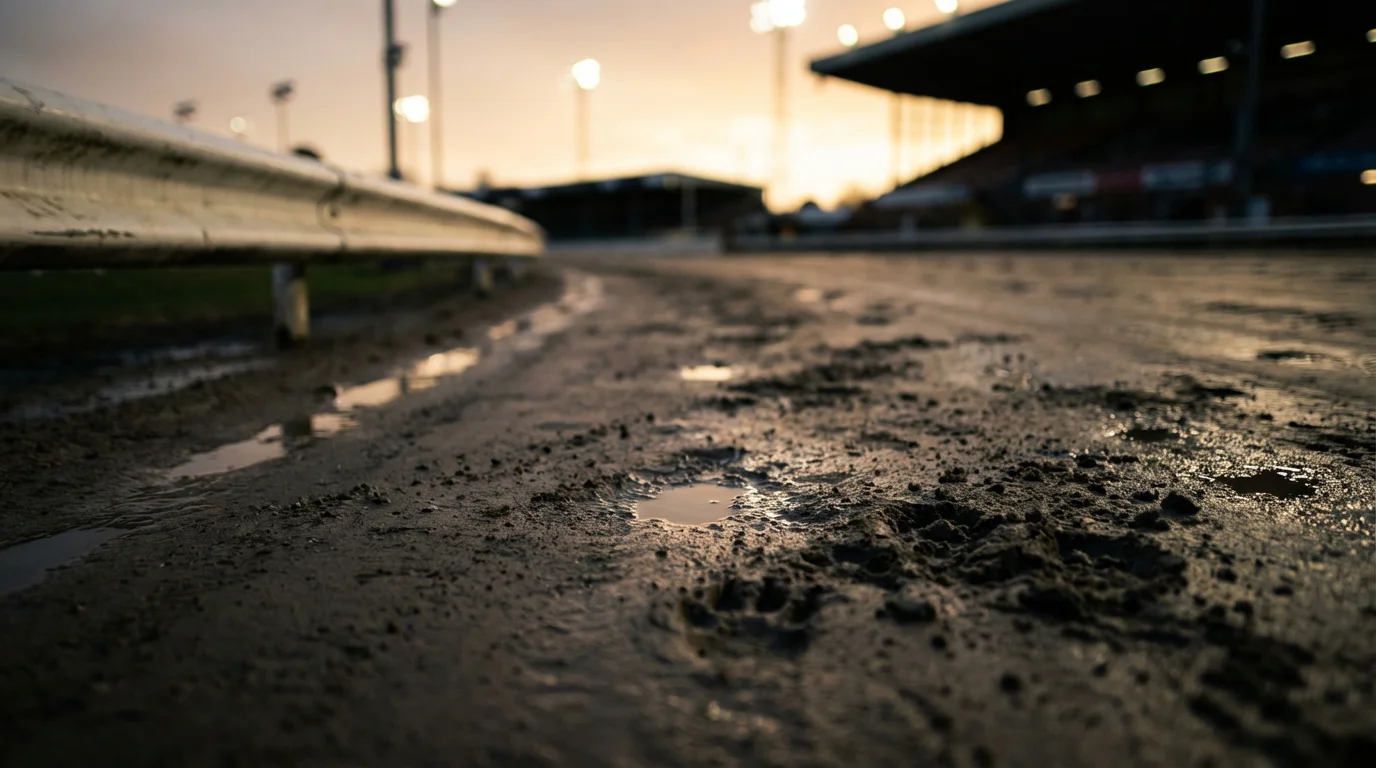
Every greyhound race in the UK is run on sand, and sand is not a constant. It absorbs rain. It dries under floodlights. It packs firm in a cold snap and rides loose on a warm evening. These shifts change how fast dogs can run, which means they change the times recorded on the racecard — and if you’re comparing those times without accounting for conditions, you’re comparing runs measured on different scales.
The going — the official assessment of track conditions — is the mechanism the sport uses to normalise this variable. It’s expressed as a simple number on the racecard, but it feeds directly into the calculated time that serious bettors rely on for form analysis. Understanding how going works, how it’s set, and how weather affects the surface beneath six pairs of sprinting legs is fundamental to reading any UK greyhound racecard accurately. Ignore the going column and you’re trusting raw times that the conditions have already distorted.
The Going Adjustment System
The going in UK greyhound racing is expressed as a numerical figure in hundredths of a second, indicating how much faster or slower the track is running compared to its standard pace. The figure is displayed in the going column of the racecard for each previous run in the form section, and it’s applied to every dog’s run time to produce the calculated time.
The scale works like this. A going figure of “N” means normal — the track is running at its baseline speed and no adjustment is needed. The calculated time equals the raw time. A positive figure — say +10 — means the track is running slow, ten hundredths of a second (0.10s) slower than normal. This allowance is subtracted from the raw time to produce the CalcTm. A negative figure — say -15 — means the track is fast, fifteen hundredths quicker than standard. The allowance is added to the raw time to normalise it upward.
The arithmetic is simple. If a dog runs a raw time of 29.80 on going of +10, its calculated time is 29.70. If another dog runs 29.50 on going of -15, its calculated time is 29.65. The first dog, despite a slower clock time, produced the faster adjusted performance. Without the going adjustment, you’d conclude the second dog was quicker by 0.30 seconds — roughly five lengths. With it, the true margin is 0.05 seconds, less than a length. That’s a significant analytical difference, and it’s one that the racecard hands you for free.
The going figure is set by the track’s racing manager, typically after observing the early races of a meeting and comparing recorded times against the track’s known standards. At most venues, the going is assessed before the first race and reviewed periodically as the meeting progresses. If conditions change materially — a rain shower midway through an evening meeting, or the sand drying rapidly under lights — the going figure can be revised. This means different races on the same card can carry different going figures, which is worth checking when comparing form from the same evening.
Some tracks publish their going figure before the meeting starts, allowing bettors to factor it into pre-race analysis. Others only confirm it once racing is underway. The Racing Post and Timeform typically display going data alongside each race’s results, and most online racecard services include it in the form section. If you’re studying form from previous meetings, the going column tells you the conditions each run was recorded under — information that’s essential for any comparison spanning more than one night’s racing.
Weather and Track Surface
UK greyhound tracks use sand as their racing surface — specifically, a prepared sand-based composite that’s graded, levelled, and maintained between races. The composition varies slightly between tracks, but the general properties are the same: sand provides grip, absorbs impact, and — crucially for going analysis — responds directly to moisture.
Rain is the most significant weather factor. A heavy downpour before or during a meeting saturates the sand, making it heavier underfoot. Dogs have to work harder through a wet surface, and times across the board slow down. The going figure rises into positive territory to reflect this, and the CalcTm adjusts accordingly. Persistent light rain has a more gradual effect, but across a twelve-race meeting, even drizzle can shift the going by five to ten hundredths of a second between the first and last races.
Frost and cold weather produce different effects. A hard frost can compact the surface, creating a faster-riding track. Morning BAGS meetings in winter sometimes record notably quick going figures because the sand has frozen overnight and not yet thawed. As the meeting progresses and the surface loosens under the impact of racing, the going can slow. Dogs that ran in the first few races of a winter morning meeting may have benefited from artificially fast conditions that didn’t persist for later races. The going column captures this if the figure was revised mid-meeting, but not all tracks reassess with the same frequency.
Warm, dry conditions — common in summer — tend to produce the most consistent going. The sand holds its shape, the surface is predictable, and going figures stay close to normal throughout a meeting. Summer form is generally considered the most reliable for comparison purposes, because the environmental variable is at its most stable. Winter form requires more caution: the same dog can post significantly different CalcTms from one week to the next, not because its ability has changed but because the surface has.
Wind is the factor most bettors overlook. A strong headwind on the home straight slows finishing times. A tailwind aids them. The going figure doesn’t capture wind directly — it’s based on overall pace, which wind affects — but a race run into a stiff headwind will produce times that overstate the surface effect. There’s no column on the racecard for wind conditions, so this is a variable you can only assess if you were watching the meeting live or checking weather reports from the evening in question. For most form analysis, it’s a marginal factor. For tight calls between two dogs with similar CalcTms, it can be the detail that tips the balance.
Seasonal patterns are worth noting at a broader level. UK tracks tend to ride faster in summer and slower in winter, with transitional going in spring and autumn. A dog whose best CalcTms all come from summer meetings might not reproduce those figures in January. Conversely, a dog that has only raced through winter might look slow on CalcTm but has been running on consistently heavy going — its true ability might be higher than the adjusted numbers suggest, depending on how accurately the going figure captured the conditions.
Factoring Going Into Your Selections
The practical application of going data in racecard analysis follows three steps: check, compare, and identify preferences.
First, check the going for each of the six previous runs shown on every dog’s form. If five runs were on normal going and one was on +20, that outlier CalcTm might look unusually good or poor — not because the dog ran differently, but because the adjustment may have slightly over- or under-corrected. Give more weight to runs on going close to normal, where the adjustment is minimal and the CalcTm is closest to the raw time.
Second, compare CalcTms across the field while noting the going range. If two dogs have similar CalcTms but one achieved its times consistently on normal going and the other did so on heavy going, the heavy-going dog’s adjusted times carry a small degree of additional uncertainty. The going correction is an approximation, not an exact science. Times recorded on extreme going — anything beyond +/- 20 — should be treated with slightly more caution than those from normal conditions.
Third, look for going preferences in each dog’s form. Some dogs produce their best CalcTms on fast going and struggle when the track is heavy. Others are mudlarks — they run their best figures when the sand is holding moisture. You can identify this by scanning the going column alongside the CalcTm column. If a dog’s starred CalcTm (its best recent adjusted time) came on going of -10 and its worst CalcTms all came on +15 or above, the dog has a clear preference for a fast surface. If tonight’s going is reported as +20, that preference is working against it — regardless of what the overall CalcTm ranking says.
Trainers know their dogs’ preferences, and some will withdraw entries from meetings where the conditions don’t suit. A trainer who pulls a dog on a wet evening and re-enters it on a dry night the following week is giving you information. The card won’t explain the withdrawal, but the pattern of entries and conditions over several runs tells the story.
When the Sand Speaks, Listen
Going is the variable that most casual bettors skip past. It sits in a small column, expressed as a number that looks cryptic until you understand the scale, and it changes from meeting to meeting in ways that aren’t visible from the racecard alone. But it feeds directly into the one figure you should be relying on for form comparison — the calculated time — and it shapes the surface that every dog in every race runs on.
A dog’s form is only as meaningful as the conditions it was recorded in. Two identical CalcTms carry different levels of reliability depending on the going they were run on. A preference for fast or slow going can turn a mid-table runner into a contender on the right night — or a favourite into a beaten one. The going column is a small piece of the racecard, but it holds disproportionate weight. Read it. Factor it in. And when the sand is talking, through a going figure that’s moved fifteen points since last week, pay attention — because the times are about to shift with it.
Get more race analysis at greyhoundracingcards.
Also read our greyhound weight changes.
