

There’s Always a Race — the Question Is Which One
UK greyhound racing runs every day of the year. Not most days. Every day. Between BAGS morning meetings, BEGS evening fixtures, and weekend open racing, the fixture list produces upwards of a hundred individual races on a typical weekday and more on Saturdays. For bettors, this volume is both a resource and a hazard. There’s always a meeting to bet on, always a racecard to study — but the sheer density of the schedule means that selectivity, not availability, is what separates productive bettors from busy ones.
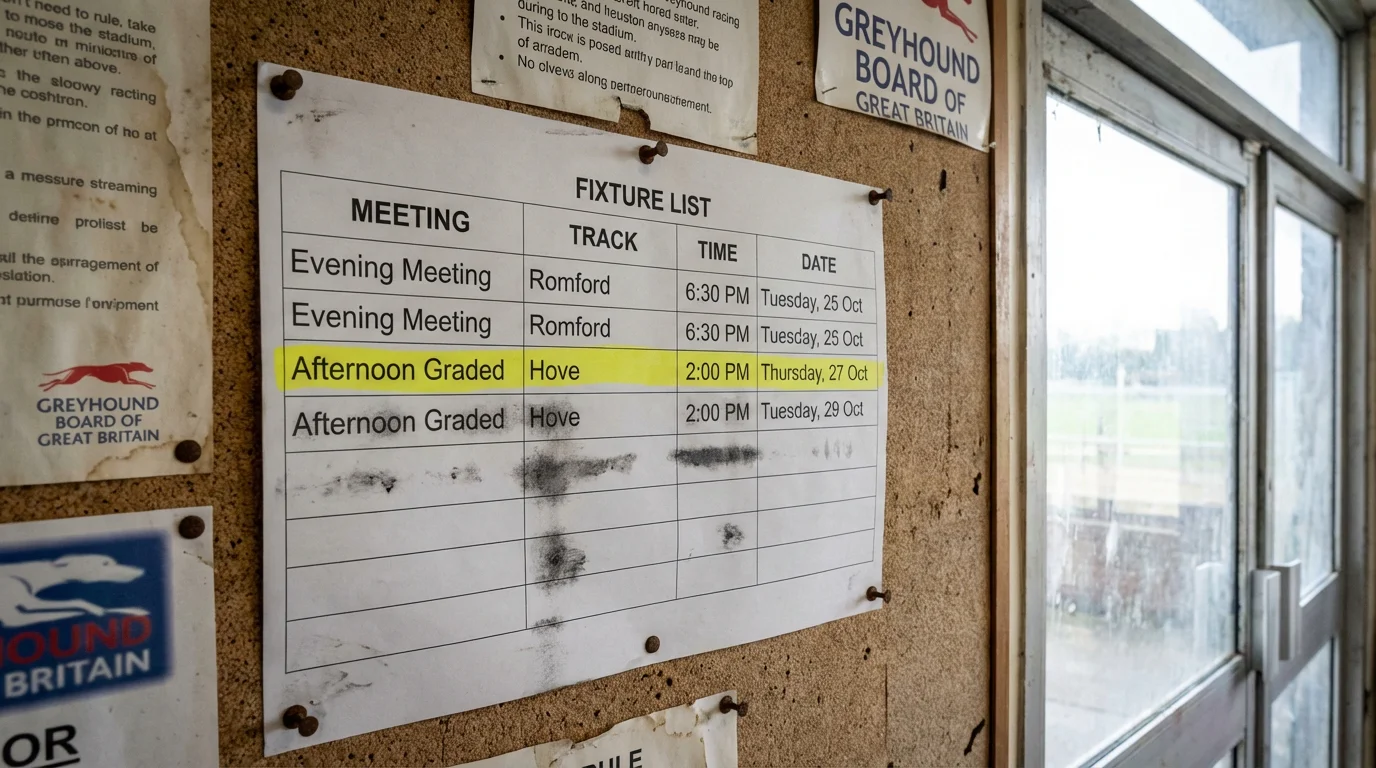
Understanding how the UK greyhound fixture calendar is structured — which tracks race when, what type of meeting runs at what time of day, and where to find the daily schedule — is basic operational knowledge. It tells you when to look for cards, where the quality is concentrated, and how to build a betting rhythm that matches the rhythm of the sport.
The Daily Structure: Morning, Afternoon, and Evening
The UK greyhound racing day splits into three broad windows, each with its own character.
Morning meetings begin as early as 10:00 or 10:30 and run through to around 13:00. These are exclusively BAGS fixtures — contracted meetings designed to supply content for betting shops and online bookmakers during the morning trading period. Morning meetings typically feature lower-grade racing at smaller or mid-sized tracks. Field quality reflects the daytime BAGS standard: competitive within grade, but generally below the level of evening open racing. Tracks like Sunderland, Kinsley, and Central Park frequently appear on the morning schedule.
Afternoon meetings pick up from around 13:00 or 13:30 and run through to 17:00 or so. These are also BAGS fixtures, continuing the supply of racing for the betting market. The tracks may overlap with the morning list or may be different venues taking the afternoon slot. A typical afternoon card comprises ten to thirteen races at intervals of roughly fifteen minutes. The grade range is similar to morning meetings, though some afternoon slots at larger tracks can feature stronger cards.
Evening meetings start from around 18:00 and run until 22:00 or later. This is where the schedule splits. Some evening meetings are BEGS fixtures — the evening equivalent of BAGS, contracted to supply betting content. Others are open meetings, independently staged by the track with higher prize money, stronger fields, and often televised coverage. The distinction matters for bettors: open evening meetings tend to feature races graded from A1 to A4, attract more informed betting money, and produce sharper markets. BEGS evenings are closer in character to the daytime BAGS schedule.
Major tracks like Romford, Monmore, Nottingham, and Sheffield host regular open evening meetings — typically on specific nights of the week that remain consistent across the calendar. Romford’s Saturday evening meeting, for example, is a fixture in the weekly schedule and reliably features high-grade racing. Knowing which tracks run open meetings on which nights allows you to plan your racecard analysis around the strongest fixtures rather than working through every BAGS card indiscriminately.
The Weekly Pattern
The greyhound fixture list follows a broadly consistent weekly shape, though the specific tracks and timing can vary.
Monday to Friday daytime is dominated by BAGS. Eight to twelve meetings spread across the country provide continuous racing from mid-morning through the afternoon. The specific tracks rotate — not every venue runs BAGS every day — but the total volume remains consistent. Friday daytime is typically the busiest BAGS day, as bookmakers anticipate higher footfall heading into the weekend.
Friday and Saturday evenings are the premium slots. Major tracks stage their feature open meetings on these nights, and television coverage concentrates here. Saturday evening, in particular, is the flagship window for UK greyhound racing — the equivalent of a Saturday afternoon in horse racing. Fields are stronger, prize money is higher, and the betting markets are deeper. If you’re going to focus your weekly analysis on a single session, Saturday evening at a major track is the most rewarding place to start.
Sunday follows a mixed pattern. Some tracks run daytime BAGS meetings. Others stage afternoon or early-evening open meetings, particularly during the summer months or around holiday weekends. Sunday evening coverage is less consistent than Friday or Saturday but can include competitive fixtures at selected tracks.
Midweek evenings — Tuesday, Wednesday, Thursday — typically feature a combination of BEGS meetings at some tracks and open meetings at others. Many tracks have a fixed weeknight for their open meeting: one venue might always race on a Tuesday evening, another on a Thursday. Learning your preferred tracks’ regular schedule saves time and lets you build track-specific knowledge across consistent weekly fixtures.
Seasonal variation adds a further layer. Summer months tend to offer the most racing, with longer daylight hours allowing additional afternoon and early-evening fixtures. Winter racing is affected by weather cancellations — frost, heavy rain, or waterlogged tracks can lead to abandoned meetings, particularly at morning BAGS fixtures. Bank holiday weekends often feature expanded schedules, with some tracks staging additional open meetings or feature events that don’t appear on a standard weekly card. Keeping an eye on the fixture list during holiday periods can uncover racing opportunities that the regular weekly pattern doesn’t include.
Where to Find the Schedule
The daily greyhound fixture list is published across several platforms, each serving a slightly different need.
The Racing Post’s greyhound section lists every meeting for the current day and the following day, with racecards available from the morning of each meeting. The interface allows filtering by track, time, and meeting type. For comprehensive daily planning, it’s the most widely used single source.
Timeform publishes daily greyhound racecards with their own ratings and analysis. The fixture list is integrated into the racecard service, so you can see the full day’s schedule alongside detailed form data for each race. Timeform’s coverage is subscription-based for full access but provides free racecards for many meetings.
Bookmaker websites and apps display the day’s greyhound fixtures as part of their betting interface. The presentation varies — some list meetings chronologically, others group them by track — but all major operators show the complete BAGS, BEGS, and open meeting schedule. The advantage of checking via a bookmaker is that early prices are displayed alongside the fixture, allowing you to combine schedule review with initial price assessment in a single view.
The GBGB’s official website (www.gbgb.org.uk) publishes fixture information for all licensed UK tracks. While it’s not formatted as a betting tool, it provides the official schedule and can confirm meeting status — useful if you’re unsure whether a specific track is racing on a given day or if a meeting has been cancelled due to weather or track conditions.
Picking Your Battles
The UK greyhound schedule offers more racing than any bettor can meaningfully analyse. That’s not a weakness of the schedule — it’s a feature. The volume means you can always find a race that suits your analytical approach, whether that’s track-specialist knowledge at a venue you follow weekly or a specific grade-drop scenario you’ve spotted across the afternoon BAGS meetings.
The discipline is in choosing where to invest your attention, not in trying to cover everything. Morning BAGS at Sunderland and Saturday evening open racing at Romford are both greyhound meetings in the UK. The quality of racing, the depth of markets, and the reliability of form data differ substantially between them. Knowing the schedule — which meetings run when, where the quality concentrates, and how the weekly rhythm works — lets you deploy your time and your bankroll where they’re most likely to produce returns.
Stay updated with racing at greyhoundracingcards.
Also explore our UK tracks guide.
