

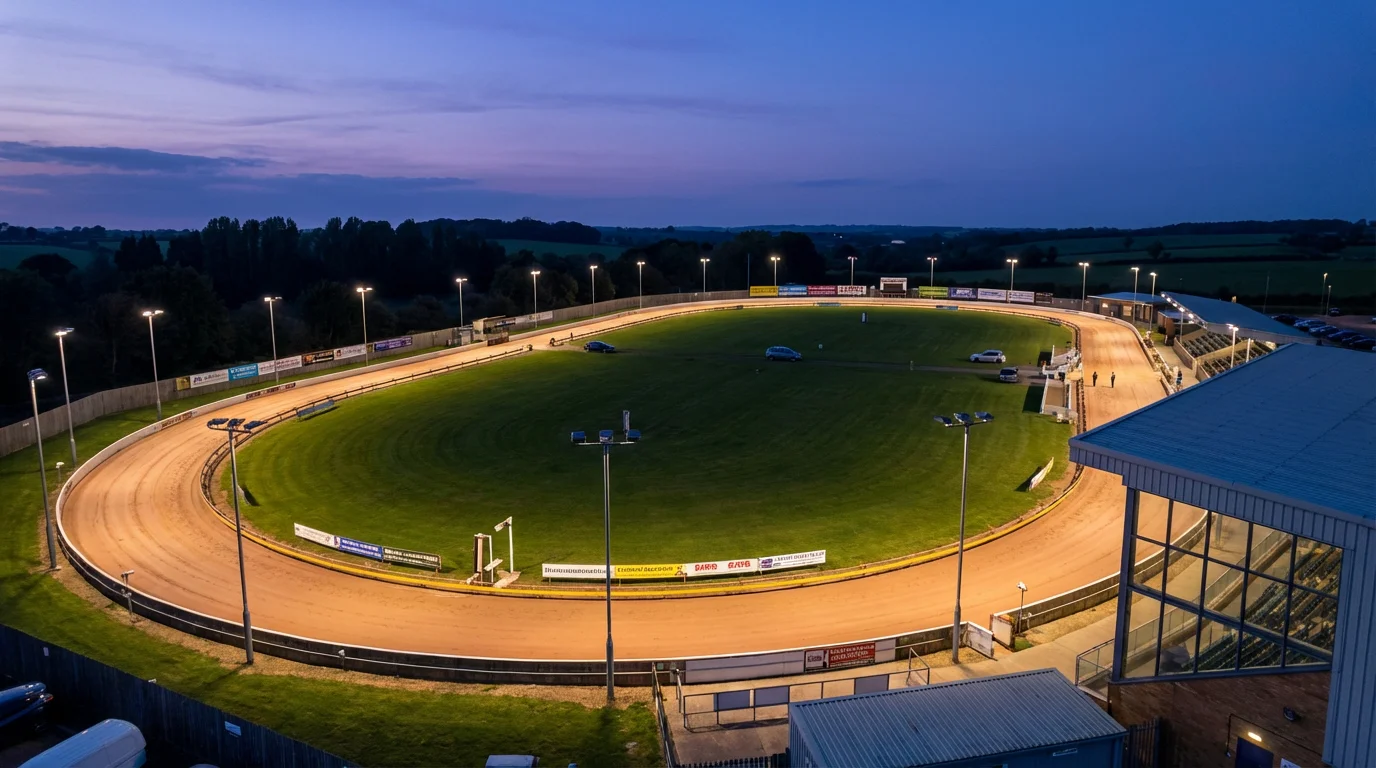
A Different Kind of Track
Towcester Greyhound Stadium in Northamptonshire occupies a unique position in UK greyhound racing. The track is one of the largest in the country, with sweeping bends and an extended circuit that produces racing dynamics distinctly different from the tight, compact ovals found at most metropolitan venues. Where Romford rewards early speed and inside draw, Towcester gives stamina, running style, and tactical flexibility more room to influence outcomes. For bettors who’ve built their racecard analysis around short-run tracks, Towcester requires a recalibration.
The venue also holds significance for the sport’s calendar: it hosts some of the most prestigious stayers’ races in the UK, including feature events that draw the country’s best long-distance greyhounds. Understanding Towcester’s characteristics — its distances, its surface, and how its geometry shapes the form data on the card — is essential if you bet on meetings here or evaluate dogs whose form includes Towcester runs.
Track Configuration and Distances
Towcester’s circuit is a large left-handed oval with a circumference of 420 metres (Greyhound Racing History), which exceeds most other UK tracks. The bends are wide and sweeping, producing less acute turns than at venues like Romford or Crayford. This geometry has a direct effect on racing: dogs lose less ground going wide, inside-rail advantage is reduced, and the transitions between straights and bends are smoother, favouring longer-striding dogs that carry momentum through turns.
The principal distances at Towcester include 500m (the standard middle-distance trip and the English Greyhound Derby distance), 712m, and the flagship 942m stayers’ distance (Dog Track UK — Towcester). The 500m race involves four bends on the main circuit and is comparable in structure to standard races at other tracks, though the wider bends mean the racing experience is different even at the same nominal distance. The 712m trip adds further ground and introduces an extra phase of racing that rewards stamina more explicitly. The 942m is a marathon by greyhound standards — twice around the full circuit — and is a distance found at very few other UK venues.
The starting position of the traps at each distance affects the run-up to the first bend, as at any track. At 500m, the run-up is moderate, and the wider bends mean the pinch point at the first turn is less severe than at tighter circuits. At 712m and 942m, the opening dynamics are similar but the extended race distance dilutes the importance of the early running — a dog that’s third or fourth at the first bend in a 942m race has far more opportunity to improve its position than the same dog in a 400m sprint at Romford.
How Towcester’s Geometry Affects Racecard Analysis
The wider bends at Towcester reduce inside trap bias compared to tighter tracks. Trap 1 still has the shortest route to the first bend, but the wider turn means the distance advantage is smaller, and dogs in outside traps lose less ground going wide. The result is a more even distribution of winners across all six traps than you’d see at Romford or Crayford, particularly at the longer distances.
This doesn’t mean trap draw is irrelevant at Towcester — it still determines starting position and first-bend dynamics — but it means the emphasis in racecard analysis shifts. At a tight track, trap draw can override moderate form differences. At Towcester, form and fitness carry more weight relative to starting position. A dog with the best CalcTm in the field from trap 4 at Towcester has a better chance of translating that form into a result than the same dog from trap 4 at Romford, because the wider bends create less first-bend congestion and more room to race.
Running style matters more here too. Wide runners, who can be disadvantaged at tight tracks because going wide adds significant extra distance, are less penalised at Towcester’s sweeping bends. A dog with a (W) designation in trap 5 or 6 at Towcester is in familiar territory — the extra distance from running wide is marginal compared to the same scenario at a track with sharper turns. Closers also benefit from the longer straights and wider bends, which give them more time and space to make up ground on the leaders.
For stayers’ races at 942m, the analytical emphasis shifts substantially towards stamina and consistency. Sectional time — the break speed — matters for the first-bend position, but the race has eight bends and two full circuits of the track. A dog that leads at the first bend but fades after 600m is a front-runner out of its depth at the distance. CalcTm history at the 942m trip, or at other stayers’ distances, is the primary form indicator. Dogs without proven form at 600m or above are speculative entries in a 942m race, regardless of how fast they are over 500m.
Reading Towcester Racecards: Adjustments to Make
When studying a Towcester racecard, adjust your weighting of the standard racecard columns to reflect the track’s characteristics.
CalcTm becomes the dominant variable. At a track where trap bias is reduced and field congestion is lower, the adjusted time is a more reliable predictor of finishing position than at venues where first-bend dynamics dominate. Compare CalcTms across the field with extra attention to consistency — a dog that posts tight CalcTm ranges at Towcester is performing on a track that allows clean running, which means the times are likely reflecting true ability rather than lucky trips.
Remarks carry a different flavour. You’ll see fewer “Crd1” and “Bmp1” entries on Towcester cards than on Romford cards, because the wider bends produce fewer first-bend incidents. When you do see interference remarks, they’re more significant — they indicate genuinely unlucky running rather than the structural crowding that tighter tracks produce as a matter of course. A “Bmp1” at Towcester means something specific happened; the same code at Romford might just mean the dog was drawn in trap 3.
Weight the going column carefully. Towcester’s surface responds to weather like any sand track, but the larger circuit means conditions can vary across different parts of the track more than at smaller venues. The going figure captures the overall pace of the meeting, but a dog that prefers the rail might experience slightly different underfoot conditions from one that runs wide. This is a marginal factor, but at stayers’ distances where the dogs cover the circuit twice, marginal factors compound.
Dogs transferring from tight tracks to Towcester for the first time should be treated with caution. The difference in track geometry is significant. A dog that thrives at Romford’s tight bends — typically a quick-breaking railer — may not handle Towcester’s sweeping turns as efficiently, particularly if its running style relies on claiming the inside rail at acute bends. Conversely, a dog that struggled at tight tracks because of first-bend crowding may find Towcester’s wider turns far more accommodating. The first run at Towcester is always informative but not always representative.
A Track for the Studious Bettor
Towcester rewards bettors who read the full racecard rather than relying on trap shortcuts. Its wider geometry reduces the noise that first-bend incidents introduce at tighter circuits, which means the form data on a Towcester card is cleaner and more directly reflective of ability. CalcTm comparisons are more reliable. Interference is less frequent. And at the stayers’ distances that define the track’s character, form analysis becomes genuinely diagnostic — the 942m trip is long enough that the best dog usually wins, provided you can identify which dog that is from the card.
If you’re used to betting at compact metropolitan tracks, Towcester asks you to adjust your hierarchy of racecard variables. Less trap, more time. Less speed, more stamina. Less first-bend chaos, more form integrity. It’s a different kind of analysis for a different kind of track — and the card gives you everything you need to make the adjustment.
Find more track guides at greyhoundracingcards.
Also explore our UK tracks guide.
