

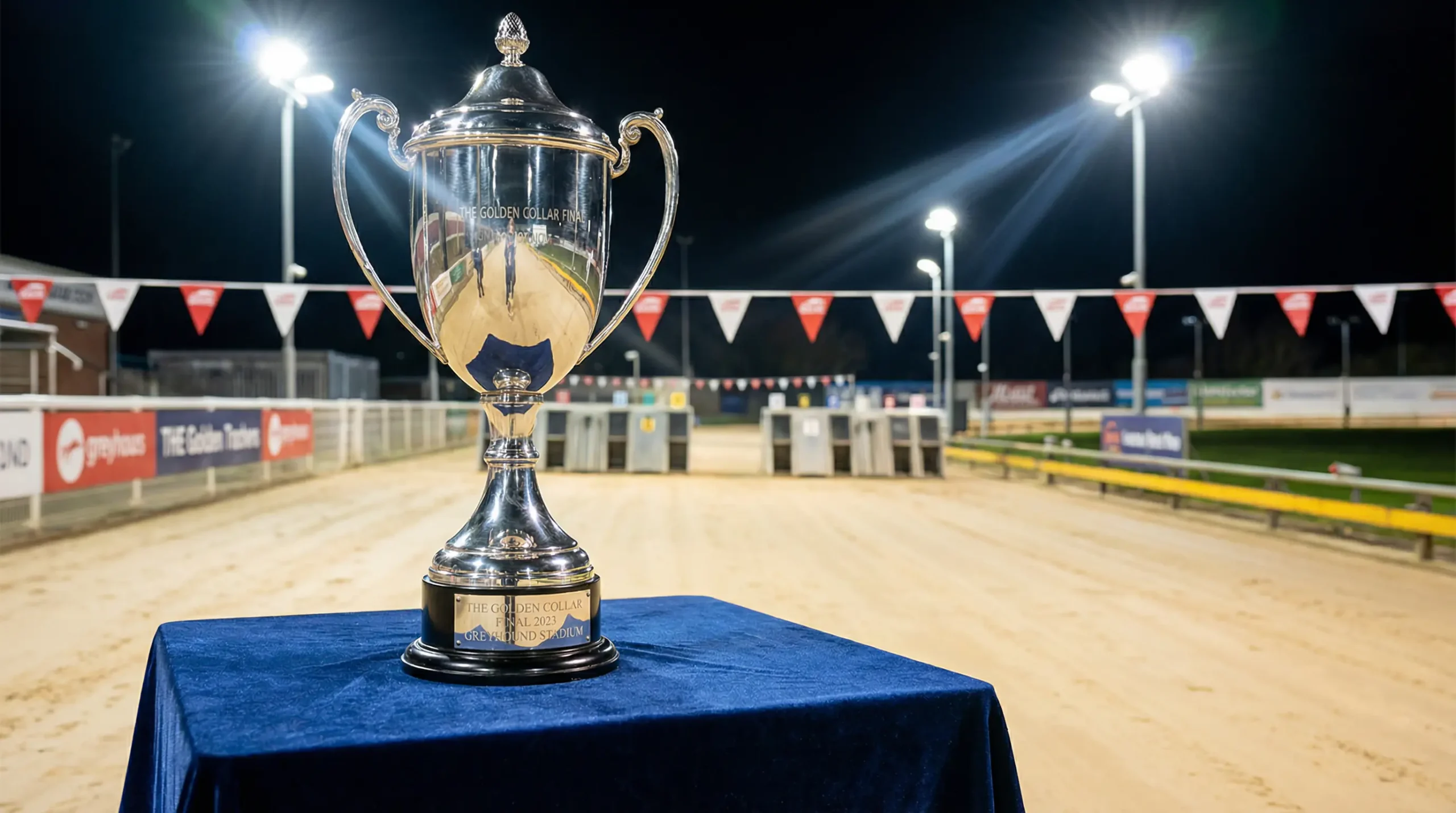
When the Grading Stops and the Racing Starts
For most of the year, UK greyhound racing is a graded sport. Dogs run at their assessed level, against opponents of similar ability, on racecards that repeat the same steady rhythm of BAGS mornings and open evenings. Then the competitions arrive — the English Greyhound Derby, the St Leger, the Cesarewitch, the Arc — and the format changes. Open entry, heats, semi-finals, and a final. The best dogs from different tracks, different trainers, and different grading systems thrown into the same fields. These are the races where reputations are made, where the form book meets the occasion, and where the racecard analysis that serves you all year needs to be adapted for a different kind of event.
Major competitions are the pinnacle of UK greyhound racing, and they attract the heaviest betting interest of the calendar. Understanding their formats, their histories, and the specific analytical considerations they demand is part of any complete approach to the sport.
The English Greyhound Derby
The English Greyhound Derby is the most prestigious event in UK greyhound racing. First run in 1927 at White City Stadium in London (Towcester Racecourse — Derby Past Winners), it has been staged at various venues over its history and is the race every owner, trainer, and breeder in the sport aspires to win. The Derby is a Category One event — the highest classification in the GBGB competition calendar — and its prize money is the largest in British greyhound racing.
The format follows a knockout structure. The competition begins with first-round heats — typically run over the standard middle distance at the host venue — with the winners and fastest losers progressing through quarter-finals and semi-finals to a six-dog final. The entire competition spans several weeks, with rounds held on successive meeting nights at the host track. This extended format means that Derby dogs race multiple times at the same venue during the competition, building a track-specific form profile that’s increasingly reliable as the rounds progress.
For bettors, the Derby presents a different analytical challenge from regular graded racing. The fields in early rounds are seeded based on form, but the quality range is wide — some heats feature clear mismatches between top-class open racers and qualifiers from lower-grade backgrounds. By the semi-finals and final, the survivors are the best of the entry, and the form is concentrated among a small group of high-ability dogs. CalcTm comparisons at this level are often very tight, and the deciding factors shift towards trap draw, running style matchups, and how each dog handles the specific pressure of competition racing — multiple hard races in a short period.
The Derby’s historical significance also creates a sentiment factor in the market. Dogs from well-known kennels or with high-profile connections may attract support beyond what their form strictly justifies. Ante-post markets — bets placed before the first round — are speculative by nature, since the draw for early heats isn’t known and the route to the final depends on which dogs end up in which heats. Post-draw betting for individual rounds is more analytically grounded, and the same racecard principles apply: CalcTm, sectional time, trap draw, and remarks.
The St Leger, Cesarewitch, and Other Category One Events
The English Greyhound St Leger is the stayers’ equivalent of the Derby. Run over a longer distance — 710m at Perry Barr and 730m at Nottingham in 2025 (GBGB) — it tests stamina and tactical ability rather than pure sprint speed. The format mirrors the Derby’s heat-to-final knockout structure. For bettors, St Leger analysis places more emphasis on CalcTm at stayers’ distances, finishing remarks (“RnOn,” “Fin”), and the dog’s proven ability to sustain pace beyond the standard 480m trip. Dogs stepping up in distance for the first time during the competition are higher-risk propositions than those with established stayers’ form.
The Cesarewitch is another major stayers’ competition, historically associated with long-distance excellence. The Arc is a premier middle-distance event. Both follow similar knockout formats and attract the sport’s best dogs over their respective distances. Each competition has its own host venue and its own history, but the analytical framework for bettors is consistent: assess the form at the specific distance, factor in the track’s characteristics, and weight the progressive form that dogs build through successive rounds at the same venue.
Below Category One, UK greyhound racing features a calendar of Category Two and Category Three competitions at tracks across the country. These events are less prestigious than the Derby or St Leger but still draw strong fields and attract significant betting interest. Local derbies, track championships, and invitation races appear regularly on evening meeting cards, and they’re identifiable on the racecard by the “OR” (open race) designation in the grade column. The competitive standard varies, but the form data is read the same way as for any other race.
Betting on Major Competitions: What Changes
Competition racing introduces variables that don’t exist in standard graded racing. The heat format means dogs are racing with more at stake than a standard grading outcome — a poor run can mean elimination, not just a grade adjustment. Some dogs rise to this occasion. Others don’t. Trainers may manage their dogs differently during competition weeks, adjusting training, trialling strategy, or race scheduling to peak at the right moment. None of this is visible on the racecard directly, but it shows up indirectly in the progressive form figures across rounds.
The multi-round structure creates its own form narrative. A dog that wins its first-round heat by six lengths, then scrapes through its quarter-final by a neck, may be tiring or may have encountered stiffer opposition. A dog that qualifies as a fastest loser in round one but then wins its quarter-final decisively is on an improving trajectory within the competition. Reading the round-by-round form — available on the racecard once the competition is underway — is more informative than looking at pre-competition form alone.
Ante-post betting on major competitions is popular but inherently speculative. The draw for each round determines which dogs face each other, and a top-class dog drawn in a strong heat faces a harder path than the same dog in a weaker heat. Once the draw is known, round-by-round betting is more analytically sound — you can assess each heat as a standalone race, using the same racecard methodology that applies to any six-dog contest.
Market depth increases for competition finals. The Derby final, in particular, attracts mainstream media coverage and significantly higher betting turnover than any regular meeting. The market is sharper — more informed money, tighter prices, less opportunity for overlooked value. In these races, the analytical edge for private bettors is smaller than in a Tuesday morning BAGS A7. The prestige is higher. The margins are thinner. The racecard is still the starting point.
The Calendar’s Peak — and What It Reveals
Major competitions are where UK greyhound racing shows its best version of itself. The fields are deeper, the dogs are faster, the stakes are higher, and the form data across multiple rounds at the same venue is richer than anything the weekly graded schedule produces. For bettors, these events offer both opportunity and challenge — opportunity because the extended form profiles are more diagnostic than a single-race snapshot, and challenge because the competition is stiffer and the market is more efficient.
Follow the competitions from the first round. Track the form as it builds. Read the heats as individual races and the overall competition as a narrative. By the time the final arrives, the racecard contains weeks of track-specific data on every surviving runner — more than enough information to form a considered view. Whether that view finds value in the market is the question that every major competition asks. The Derby doesn’t make it easy. That’s the point.
Get more race guides at greyhoundracingcards.
Also read our greyhound race grades.
