

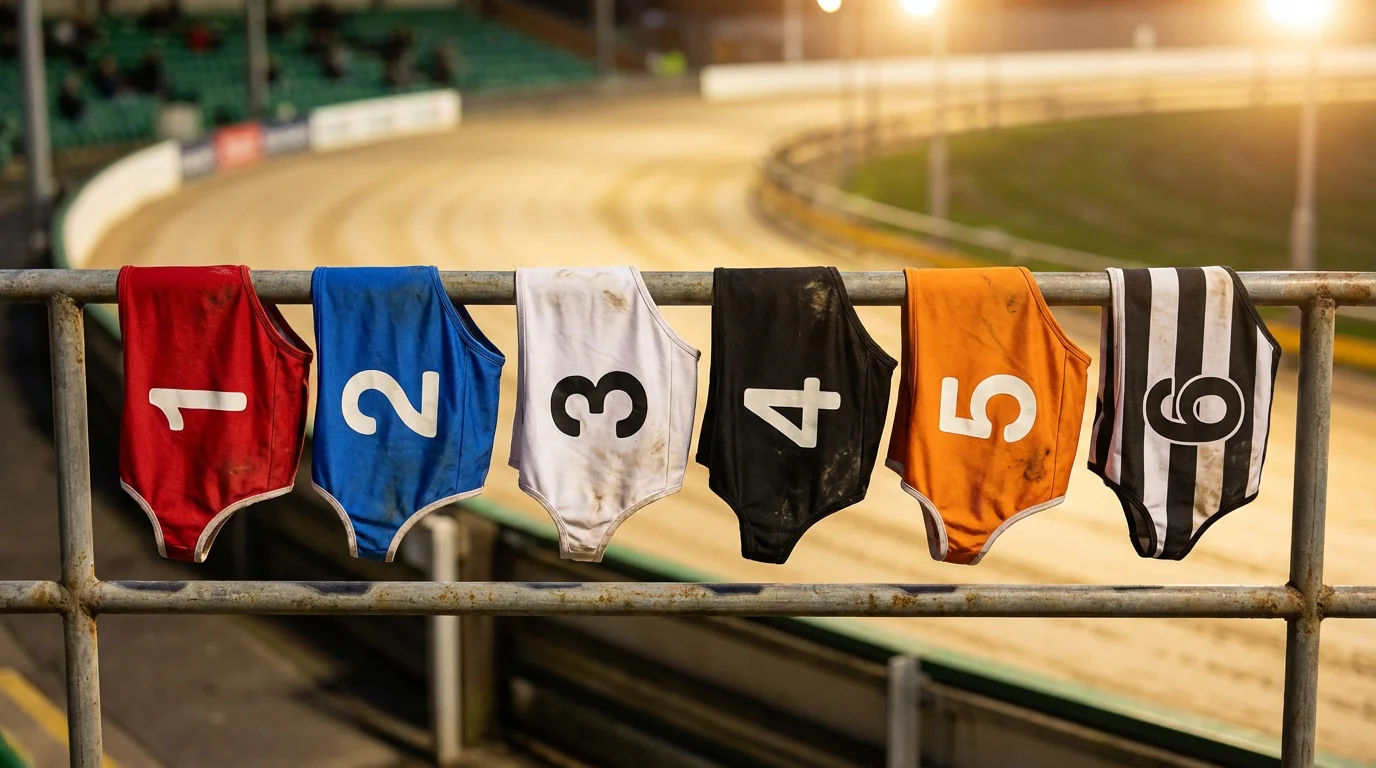
Every Trap Has a Colour — and a Story
Red jacket, inside rail — that’s trap one. If you’ve ever watched greyhound racing on screen or trackside, you’ve seen those six coloured jackets blur past the starting boxes and wondered whether the colours are decorative or functional. They’re functional. Every trap number in UK greyhound racing corresponds to a specific jacket colour, and the system has remained unchanged for decades for one simple reason: when six dogs are sprinting around a sand track at close to 45 mph, you need to tell them apart instantly.
But trap numbers do more than identify runners. The number printed beside a greyhound’s name on the racecard tells you where it starts — how close to the inside rail, how far from the first bend, and in many cases, how compatible the draw is with the dog’s natural running style. At some tracks, the trap alone can tilt the odds. At others, the effect is subtle but still measurable. Either way, ignoring the trap column on a racecard means ignoring one of the most accessible pieces of information the card provides.
This guide breaks down the trap numbering and colour system used across all licensed UK tracks, explains why position matters, and shows how draw bias and running style interact to shape race outcomes. Whether you’re visiting the dogs for the first time or refining an existing approach to racecard analysis, the trap is where every race — and every reading of the card — begins.
The Six Trap Colours and What They Mean
Learn the colours once and you’ll read the race at a glance. The system applies uniformly at every GBGB-licensed track in the UK, so whether you’re watching from Romford or following a BAGS meeting at Sunderland, the same six colours correspond to the same six traps.
| Trap | Jacket Colour | Number Colour | Track Position |
|---|---|---|---|
| 1 | Red | White | Innermost — closest to the rail |
| 2 | Blue | White | Second from inside |
| 3 | White | Black | Centre-inside |
| 4 | Black | White | Centre-outside |
| 5 | Orange | Black | Second from outside |
| 6 | Black and white stripes | Red | Outermost — furthest from rail |
Trap 1 sits directly against the inside rail, and the numbers ascend outward. Trap 6, wearing the distinctive striped jacket, begins furthest from the rail. In races with fewer than six runners — sometimes seen in trials or when non-runners reduce a field — the remaining traps still carry their standard colours. A reserve dog entering the field wears an “R” on its jacket in addition to the assigned trap colour.
From a practical standpoint, these colours matter most at the track or when watching a race live on screen. Greyhounds move fast and bunch tight through the bends. Picking out “the blue jacket” is significantly quicker than trying to read a number on a moving dog. Online racecards and results pages typically colour-code each runner’s row to match the jacket, so the same visual shorthand carries into digital form study. After a handful of races, the association becomes automatic: red means inside, stripes mean outside, and everything else falls between.
The colour system also serves a secondary function in racecard abbreviations. When form remarks reference a dog’s track position — “Rls” for rails, “Mid” for middle, “W” for wide — those positions correspond roughly to trap zones. A dog drawn in trap 1 or 2 is expected to run the rail. A dog in trap 5 or 6 has more room on the outside. When a dog’s natural preference doesn’t match its drawn position, that conflict becomes one of the most useful signals on the card.
How Trap Position Creates Draw Bias
Draw bias is the card’s silent partner. It doesn’t appear as a column on the racecard and no abbreviation flags it in the remarks, yet at many UK tracks the trap a dog starts from has a measurable effect on its winning chances — before a single stride is taken.
The core mechanic is straightforward. UK greyhound tracks are oval circuits with bends, and the starting boxes are positioned on a straight section of the track. The distance between the traps and the first bend varies from track to track — some have a long run-up, others put the dogs into the first turn within a few seconds of the lids opening. That run-up distance is the single biggest determinant of draw bias. A short run to the first bend compresses the field and rewards dogs that can secure a position quickly. A longer run-up gives every dog more time to settle into stride, diluting the positional advantage of any particular trap.
At tracks with a short run-in, trap 1 often holds a statistical edge. The dog on the rail has the shortest route to the bend and, if it breaks cleanly, can establish inside position before the rest of the field converges. Trap 6, by contrast, has the widest arc to navigate but also the most room. A strong wide runner drawn in trap 6 at a track like Romford can sweep around the outside without interference, and at some circuits, trap 6 wins more often than the middle traps precisely because of that freedom from traffic.
The middle traps — 3 and 4 — are generally considered the least advantageous. Dogs in these positions have no natural edge: they’re not close enough to the rail to claim it, and not wide enough to avoid the dogs either side of them. At the first bend, the middle traps are where crowding happens. Form remarks like “Crd1” (crowded at the first bend) disproportionately appear against dogs drawn in traps 3 and 4, which isn’t a coincidence.
Trap bias is not uniform across the country. Each track has its own geometry, its own run-up distances, and its own patterns. Romford’s tight left-handed circuit favours inside draws at sprint distances. Towcester’s sweeping bends reduce the inside trap advantage. Sheffield’s track characteristics create a different distribution again. Serious card readers track these patterns over time or consult trap statistics published by services like Timeform and the Racing Post. The numbers won’t predict individual races, but they reveal the underlying tilt of the surface.
There’s also a temporal dimension. Track conditions shift across a meeting. Sand that was watered before the first race dries through the evening. The going changes, and with it, the relative advantage of different traps. A rail that rode fast during the early races might slow later. These micro-shifts don’t appear on the printed racecard, but they’re visible in the results as a meeting unfolds — and they’re why experienced bettors don’t commit to early-race analysis for later races without adjustment.
None of this means you should bet a trap number instead of a greyhound. But it does mean the trap column on the racecard is carrying more information than a simple starting position. It’s carrying the track’s geometry, the distance’s characteristics, and a set of probabilities that the rest of the card either confirms or contradicts.
Running Style and Trap Assignment
A railer in trap 5 is a dog fighting against its own instincts. Every greyhound has a preferred running line — some hug the inside rail, some drift wide, and some carve a path down the middle. The racecard tells you about this preference through two channels: historical remarks and the explicit “(W)” wide runner designation.
Railers are dogs that consistently run closest to the inside rail. Their form remarks will show patterns like “Rls” (rails), “RlsStt” (rails from start), or “RlsTMid” (rails to middle). These dogs perform best when drawn in traps 1 or 2, where their natural instinct to seek the rail aligns with their starting position. Draw a railer in trap 4 or 5, and it needs to cut across one or more rivals to find its preferred line — a manoeuvre that costs lengths, risks interference, and often shows up in the remarks as “Crd” or “Bmp.” The racecard won’t say “poorly drawn,” but the mismatch between running style and trap number says it clearly enough.
Wide runners receive the “(W)” notation on the racecard, placed after the dog’s name. This designation tells the grading officer to allocate the dog to an outside trap — typically 5 or 6. Wide runners prefer to race on the outside of the pack, often sweeping around rivals on the bends. When the draw matches the style, these dogs can exploit the extra room that outside traps provide. When it doesn’t — a wide runner drawn in trap 2, for instance — the same dog that looked comfortable in previous outings can become hemmed in and frustrated, producing form figures that don’t reflect its actual ability.
Middle runners are the least predictable group. They don’t commit to the rail or the outside and tend to race wherever space appears. This flexibility is an advantage in some fields — they can adapt to the pace scenario — but it also makes them vulnerable to traffic, because the middle of the track is where congestion peaks at the bends. Dogs with “Mid” appearing consistently in their remarks are middle runners. They’re generally less affected by trap draw than pure railers or wide runners, but they’re more affected by the composition of the field around them.
The practical application is direct: when you read the racecard, cross-reference each dog’s running style with its trap draw. A railer in trap 1 with clear form at this track is in its comfort zone. The same dog in trap 4, surrounded by dogs with early pace, faces an entirely different race. The form figures might look identical, but the context isn’t. This is the kind of second-layer analysis that separates a trap number from a piece of intelligence — and it’s available on every racecard for every race, if you take the time to read it.
Trainers are aware of these dynamics. Some will request specific trap allocations or time their dogs’ entries to coincide with favourable draws. Others move dogs between tracks to find a circuit that suits their running style. The racecard doesn’t tell you about these decisions directly, but a pattern of consistent draw-and-style alignment across recent runs is a sign that a trainer is managing the dog’s opportunities carefully. That’s a positive signal.
What the Trap Number Won’t Tell You
The trap is a starting point — literally and analytically. It tells you where the dog begins, what colour it wears, and how the track’s geometry might tilt the early running. Used alongside form, sectional times, and grade data, it’s a valuable filter. Used alone, it’s a lottery ticket with a colour scheme.
Draw bias gives you probabilities, not certainties. A dog with the best calculated time in the race, dropping in grade, and drawn in a favourable trap is a strong candidate. A dog drawn in trap 1 with declining form and an upward grade move isn’t rescued by the rail. The trap number enriches your reading of the card — it shouldn’t replace it. Treat it as one data point in a six-column assessment, and it’ll serve you well. Treat it as the answer, and the dogs will remind you, quickly and expensively, that racing has six runners for a reason.
Find more race guides at greyhoundracingcards.
Also read our how trap draw affects outcomes.
