

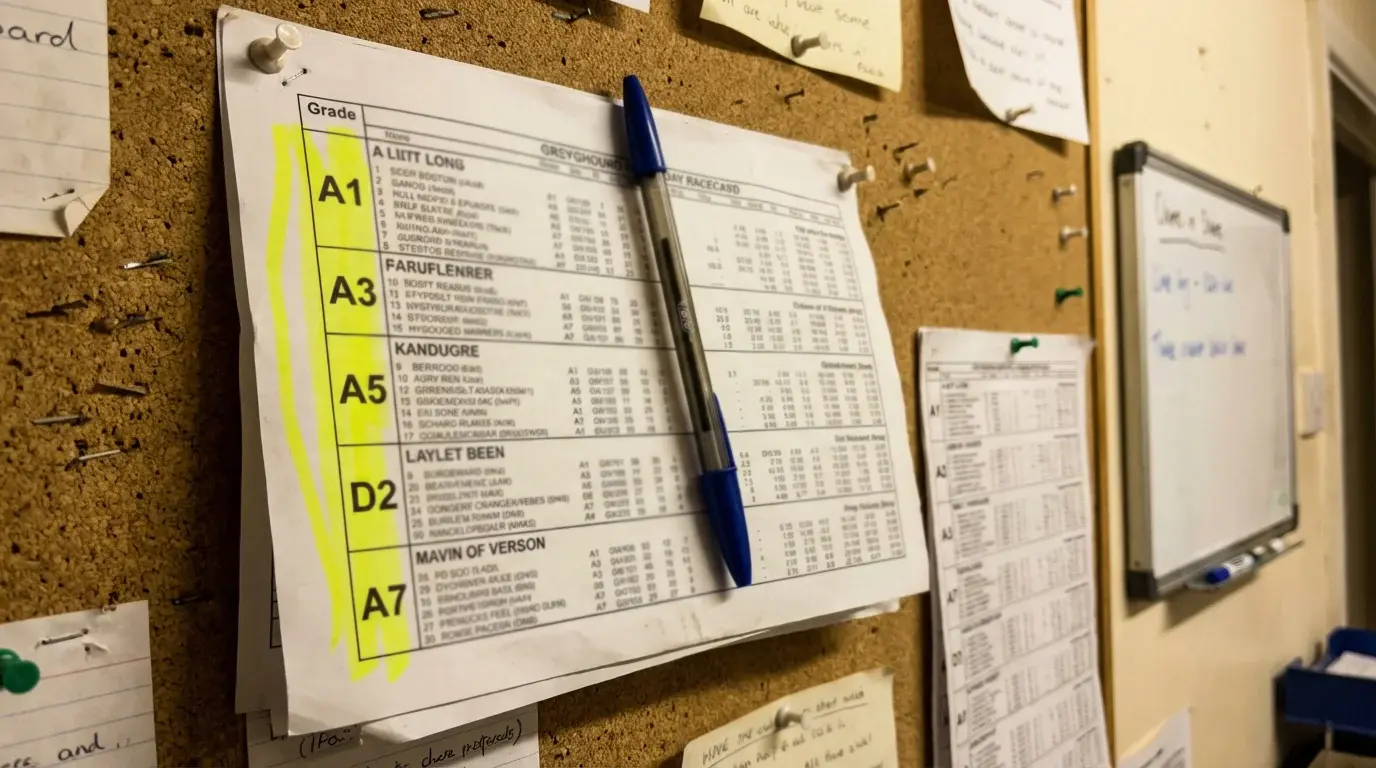
Grades Aren’t Rankings — They’re Battlefields
A6 doesn’t mean mediocre — it means matched. The grading system in UK greyhound racing exists for a single purpose: to pit dogs of similar ability against each other. It’s a handicapping mechanism, not a league table. A dog racing in A6 at Romford isn’t six levels worse than a dog in A1 at the same track. It simply runs slower calculated times over the same distance, and the grading system sorts it into a field where it has a competitive chance.
For bettors, the grade column on a racecard carries more strategic information than most people extract from it. It tells you the standard of competition in the race, but more importantly, it tells you where each dog has been and where it’s heading. A dog stepping up from A5 to A3 faces stiffer opposition. A dog dropping from A2 to A4 has been given an easier assignment. Both shifts show up on the racecard if you know where to look — and both create opportunities that the odds don’t always reflect.
This guide covers every grade classification used under the GBGB framework, explains how promotion and demotion work, and shows how to use grade data as part of your racecard analysis. If you’ve ever looked at a racecard and skipped past the grade letter because it seemed like background information, this is where you learn to stop doing that.
The Full UK Greyhound Grading System
The letter tells you the distance. The number tells you the level. Every graded race at a GBGB-licensed track in the UK uses a classification that combines a distance category with a performance tier. Once you understand the format, you can decode any grade on any racecard in seconds.
The distance categories are as follows:
| Letter | Category | Typical Distance |
|---|---|---|
| A | Standard / Middle Distance | 380m–500m |
| D | Sprint | 210m–380m |
| S | Stayers | 600m+ |
| OR | Open Race | Varies |
| M | Maiden | Varies |
| H | Hurdles | Varies (rare) |
The “A” category dominates UK greyhound racing. The vast majority of graded races at most tracks fall within the standard middle-distance range — typically around 480m, though the exact distance varies by circuit. Sprint “D” races over shorter distances appear on most cards too, particularly at morning and afternoon BAGS meetings. Stayer “S” races are less frequent but feature at tracks that offer longer distances like Towcester (712m) and Monmore (630m–684m). Marathon “E” races over eight bends or more are the longest distances available, with Towcester offering marathon races of up to 942m.
The number that follows the letter denotes the performance tier. For “A” races, the scale runs from A1 (the fastest dogs at the track) down to A11 (the slowest graded dogs). Not every track uses all eleven tiers — smaller tracks might grade from A1 to A7, while busier venues with deeper kennels extend the range further. Sprint grades typically run D1 to D4 or D5. Stayer grades run S1 to S3 at most venues.
Open races carry the “OR” designation and sit outside the normal grading ladder. These are invitation events or feature races where the standard grading criteria don’t apply. Open races often attract the strongest dogs at a track and are common at evening meetings and televised fixtures. Prize money is typically higher, and the fields can include dogs from different grade bands competing against each other.
Maiden races are for dogs that haven’t yet won a graded race at the track. Once a maiden wins, it enters the grading system and is assigned a grade based on the time it ran. Hurdle races — denoted by “H” — still exist on paper but are extremely rare in modern UK racing. You might go years without seeing one on a racecard.
The key point for racecard analysis is that the grade tells you the competitive standard of the race. An A3 at Romford is not the same as an A3 at Sunderland, because each track’s grading is relative to its own population of dogs. A dog graded A3 at a strong track might be graded A1 at a weaker one. This is why comparing grades across tracks is unreliable — and why calculated time, adjusted for going, is a better measure of absolute ability than grade alone.
How Dogs Move Between Grades
Win two in a row and the grade goes up. That’s not a reward — it’s a test. The GBGB’s grading rules are designed to keep dogs racing against opponents of comparable ability, and the primary mechanism is simple: winners go up, losers go down.
The specifics vary slightly between tracks, but the general framework works like this. A dog that wins a race is typically raised by one grade for its next outing. Two consecutive wins can result in a two-grade rise. Conversely, a dog that finishes consistently out of the places over several runs may be dropped a grade to find a more suitable level. The racing manager at each track has discretion in applying these rules, and grading decisions are made after each meeting based on results and running times.
Trainers have some influence over this process. They can request that a dog be entered at a specific grade if they believe the current grading doesn’t reflect the dog’s current form or fitness. A trainer might withdraw a dog from competition for a period and return it at a lower grade, particularly if the dog has had a break due to injury or a change in condition. Trial runs — visible on the racecard as “T3” or “T4” in the class column — are often used to establish or re-establish a dog’s grade after time away.
Grade movement is one of the most underused pieces of information on a racecard. The form section shows the class of each previous race, reading from top (most recent) to bottom (oldest). If you see a dog’s grade column showing A4, A4, A3, A3, A2, A2 across its last six runs, you’re looking at a dog that’s been steadily demoted — probably because its times haven’t kept pace with the competition at higher grades. That’s a clear signal. Conversely, a dog showing A6, A5, A5, A4, A4, A3 is climbing, winning at each level and being pushed into tougher company. Whether it can handle the next step is the question the card invites you to answer.
Speed of grade movement matters too. A dog that drops two grades in two weeks has likely run badly or returned from a break in reduced form. A dog that rises two grades over six weeks has been consistently competitive at every step. The timeline is visible in the date column alongside the grade column. Reading both together gives you a trajectory — and trajectories, in graded racing, are more useful than snapshots.
Using Grades to Spot Betting Opportunities
The smartest bet in graded racing is on the dog dropping down — if the card supports it. A grade drop is the most common source of overlooked value in UK greyhound betting, and it’s hiding in plain sight on the racecard every day of the week.
Here’s the logic. A dog racing in A3 that gets beaten by three lengths in each of its last two starts will likely be dropped to A4 for its next outing. At A4, it’s racing against slower dogs — dogs whose calculated times are measurably worse than the field the dropping dog was competing against a week ago. If the dog’s own CalcTm is competitive with or better than the A4 standard, the grade drop has created a mismatch. The dog hasn’t suddenly improved. The opposition has simply weakened. And yet the market doesn’t always price this correctly, because casual bettors focus on the result (“lost its last two”) rather than the context (“lost at a higher level and is now facing weaker dogs”).
The reverse situation — a dog rising in grade after recent wins — is a legitimate warning sign. Promotion means the dog is about to face faster opposition. Its recent winning form was achieved against weaker fields, and the calculated times it posted may not be good enough at the new level. This doesn’t mean every promoted dog will lose, but it means the recent form figures need to be tested against the standard of the new grade. Check the CalcTms of the dog’s upcoming opponents. If the field’s best times are half a second quicker than the promoted dog’s recent efforts, the step up may be too steep.
Grade-hopping dogs present a different challenge. Some greyhounds oscillate between two grades — winning at A5, getting promoted to A4, losing, dropping back to A5, winning again, and repeating the cycle. The racecard reveals this pattern clearly if you read the class column across all six runs. These dogs are essentially A5 specialists who can’t quite compete at A4. Backing them at A5 is straightforward. Backing them at A4 is optimistic. The card tells you which version of the dog you’re betting on — you just need to check which grade the current race falls into.
There’s also a subtler angle: grade as a proxy for field strength. An A2 race at a track with deep kennels is a strong contest. The same grade at a track with fewer dogs in training might be a thinner field with wider ability gaps. When the card shows you a mixed-grade race — an open event or an invitational — the grade history of each runner becomes your primary tool for sorting the contenders from the passengers. Whose CalcTm at their regular grade translates best to this one-off competition? That’s the question grade data helps you answer.
Finally, combine grade information with going data. A dog that posted excellent CalcTms at A3 on fast going might struggle at the same grade on slow going. If it’s then dropped to A4 on a slow-going night, the grade drop alone doesn’t guarantee competitiveness — you need to check whether the dog handles the surface. Grades don’t operate in isolation. They operate alongside every other column on the card. Your job is to assemble the full picture.
Grades as Context, Not Destiny
Grades frame the race. Form decides it. The grading system gives you the competitive landscape — who’s moving up, who’s dropping down, and what standard of opposition each dog is facing. But a grade is a label assigned after the fact, based on recent results. It’s not a prediction. A dog graded A4 today might run a time that would be competitive at A2. It might also produce its worst performance in weeks. The grade tells you what was expected of the dog. The card tells you what the dog actually did.
Use grades as a filter, not a verdict. Check the grade of the current race against each dog’s recent grade history. Flag the drops, question the rises, and recognise the oscillators. Then look at the CalcTms, the trap draw, the running style, and the remarks. The grade column is one column on the racecard. It’s a good one. But it works best when it works with the others.
Find more race guides at greyhoundracingcards.
Also read our greyhound derby and competitions guide.
