

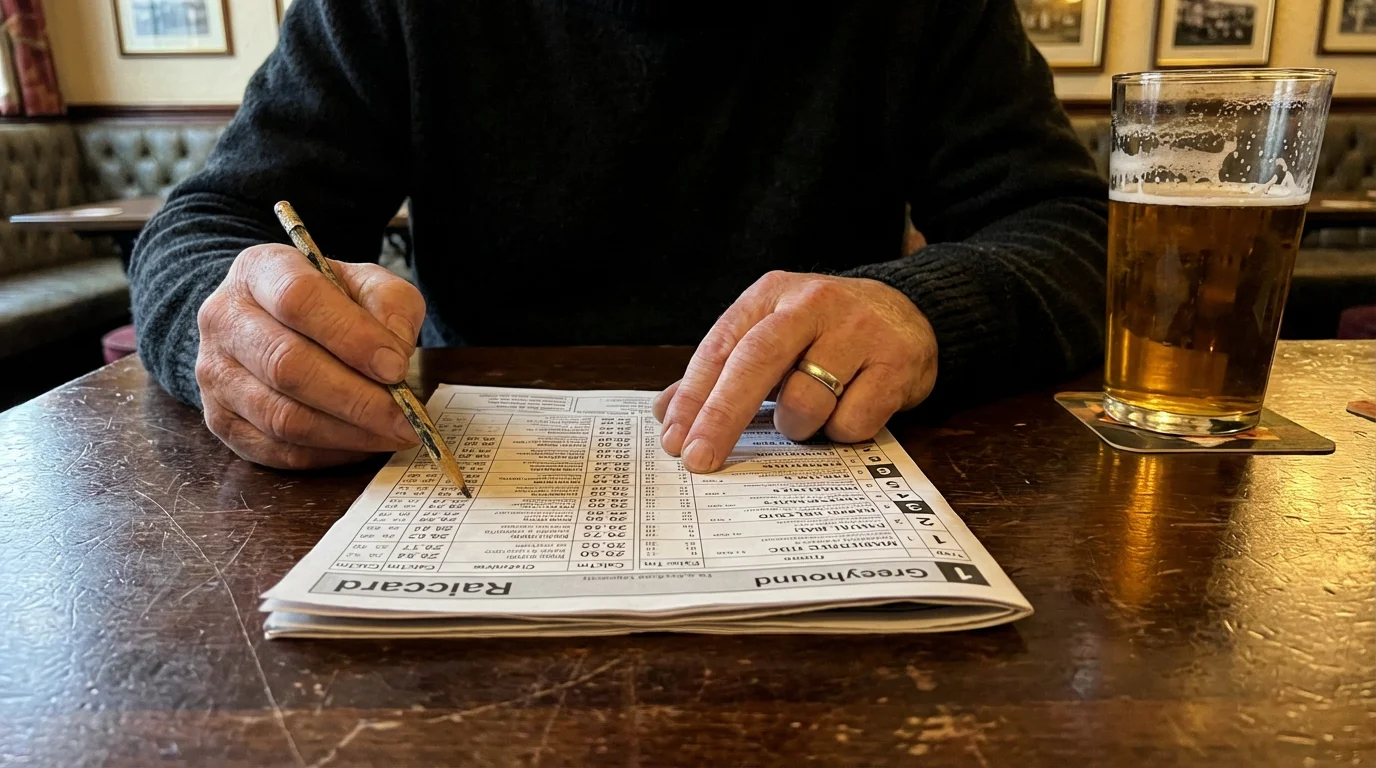
Two Times, One Truth
Every greyhound racecard shows two time figures for each previous run, and most bettors look at the wrong one. The winning time — the raw clock reading from traps to finish — is the number that catches the eye first. It’s clean, it’s simple, and it’s misleading. The calculated time, listed separately and marked with an asterisk when it represents the dog’s best recent effort, is the figure that actually tells you how fast the dog ran relative to the conditions. One is a stopwatch reading. The other is an adjusted measurement. For any serious racecard analysis, the distinction matters more than most people realise.
The confusion is understandable. In horse racing, the official time is the time. In athletics, the clock is absolute. But greyhound racing runs on sand, and sand changes. The same track on the same evening can ride fast or slow depending on moisture, temperature, and how many races have already churned up the surface. A dog that clocks 29.40 on a fast-going night and 29.80 on a slow-going night might have produced identical levels of effort. The winning time doesn’t account for that. The calculated time does.
This guide explains what each time figure represents, how the going adjustment works, what the asterisk notation signals, and how to use calculated time as the primary comparison tool when evaluating a race. If you’ve been ranking dogs by their fastest raw time, you’ve been using an unreliable ruler.
What Winning Time Actually Tells You
The winning time — often labelled “WinTm” on the racecard — is the official clock time of the race winner, measured from the opening of the traps to the first dog crossing the finish line. For each dog in the race, the card also records its own run time, adjusted for the distance it was beaten by. If the winner ran 29.50 and a dog finished two lengths behind, that dog’s time will be calculated at roughly 29.62, since one length equates to approximately 0.07 to 0.08 seconds at full speed (as noted by Timeform).
The winning time is a fact. It happened. The stopwatch doesn’t have an opinion. But facts without context can mislead. A winning time of 29.30 at Romford on a fast-going night might represent the same level of canine performance as a 29.70 at the same track a week later when the sand was heavy after rain. If you compared those two dogs purely on winning time, you’d conclude the first was nearly half a second faster. In reality, the going did the work — not the dog.
This is why experienced form readers treat winning time as background information rather than frontline data. It tells you the raw clock, which has some utility for confirming the pace of a race and checking whether times are broadly consistent with the grade. But it doesn’t tell you how the dog would have performed on a different night, at different going, against a different field. For that, you need the time to be adjusted.
Winning time is also vulnerable to race dynamics. A dog that led from trap to line on a clear run will post a faster time than one that was bumped at the second bend, checked, and had to make up ground. Both times appear on the racecard, but one reflects uninterrupted ability while the other reflects a compromised run. The winning time doesn’t flag this distinction. The remarks column does — and so does the calculated time, to a degree, because the going adjustment at least removes the environmental variable even if it can’t remove the interference one.
Calculated Time: Adjusting for the Going
The calculated time — typically labelled “CalcTm” on UK racecards — takes the winning time and adjusts it for the going allowance. The going allowance is a figure, expressed in hundredths of a second, that represents how much faster or slower the track was running compared to its standard baseline on the night of the race.
The notation works as follows. A going figure of +10 means the track was running 0.10 seconds slow — the sand was heavy, and times across the meeting were slower than normal. The CalcTm for each dog adds this allowance to compensate: if a dog’s raw run time was 29.80 and the going was +10, its CalcTm would be 29.70, reflecting what the dog would have run under normal conditions. Conversely, a going figure of -10 means the track was 0.10 seconds fast, and the CalcTm adjusts upward: a raw time of 29.30 becomes a CalcTm of 29.40.
“N” in the going column means normal going — no adjustment applied. The CalcTm equals the raw time.
Here’s a worked example. Two dogs from the same track, same distance, racing on different nights:
| Dog | WinTm | Going | CalcTm |
|---|---|---|---|
| Dog A | 29.35 | -15 (fast) | 29.50 |
| Dog B | 29.72 | +20 (slow) | 29.52 |
On raw winning time, Dog A looks 0.37 seconds faster — a margin of roughly six lengths. But the going tells a different story. Dog A ran on a surface that was riding 0.15 seconds fast. Dog B ran on a track that was 0.20 seconds slow. Once adjusted, the difference between them is just 0.02 seconds — barely a neck. These two dogs, despite wildly different clock times, are virtually identical in ability when you strip out the conditions.
This is why CalcTm is the time that matters for form comparison. It normalises every run to a standard baseline, allowing you to compare dogs across different meetings, different going conditions, and different phases of the racing calendar. Without the adjustment, form analysis over any period longer than a single meeting becomes unreliable. With it, you can confidently compare a run from January’s heavy going with a run from July’s fast summer surface.
The going allowance is set by the track’s racing manager, usually based on the early races of a meeting. It can sometimes be revised mid-meeting if conditions change significantly — after rain, for instance, or as the sand dries under floodlights. This means the going figure applied to race one and race twelve on the same card might differ. Most racecard services display the going figure per race, not per meeting, which is worth checking when you’re comparing form from the same evening.
The Star: Best Recent Calculated Time
When you see an asterisk (*) next to a CalcTm figure on the racecard, it marks that run as the dog’s best recent calculated time over the distance. This is a quick-reference indicator provided by racecard services to flag the standout performance in the dog’s recent form.
The starred time is useful as a scanning tool. When you’re working through a six-dog racecard quickly, you can glance at the starred CalcTm for each runner and immediately identify the dog with the fastest adjusted time in the field. That doesn’t mean it’ll win — form is more than one number — but it tells you which dog has demonstrated the highest level of ability under normalised conditions in its recent outings.
Be cautious with the asterisk, though. The best recent CalcTm might come from a run where the dog had an ideal trip — clear run, good draw, no interference. If every other recent run shows CalcTms significantly slower than the starred one, the starred time might represent the ceiling of the dog’s ability rather than a repeatable standard. Check the context of the asterisked run. Was the going genuine? Was the field competitive? Was the dog’s running style suited to the trap it was drawn in? A starred CalcTm that came from a perfect set of circumstances is less reliable as a predictor than a slightly slower CalcTm that the dog produces consistently.
Conversely, a dog whose starred CalcTm is only marginally faster than its other recent CalcTms is showing consistency. That’s a stronger signal than one big number surrounded by mediocre ones. Consistent CalcTms mean the dog is operating near its true level, and you can bet on that level with reasonable confidence. Volatile CalcTms mean you’re guessing which version of the dog shows up.
Using CalcTm to Compare Dogs in the Same Race
The most practical application of calculated time is direct comparison within a single race. Pull the CalcTms for all six runners, using their best recent and their average recent figures, and rank them. The dog with the fastest consistent CalcTm has the strongest form claim on paper.
This comparison only works reliably when the CalcTms come from the same track and the same distance. A CalcTm of 29.40 at Romford’s 400m doesn’t compare meaningfully with a CalcTm of 29.40 at Nottingham’s 480m — different distances, different tracks, different baselines. For dogs moving between tracks, CalcTm comparisons become approximations at best. In those cases, ratings from services like Timeform, which adjust for track differences, offer a more reliable cross-venue comparison.
Within a single-track, single-distance race, though, CalcTm is the sharpest tool available. A field where the top CalcTm is 29.35 and the next best is 29.55 has a clear standout. A field where four dogs sit between 29.40 and 29.48 is tightly matched, and other factors — trap draw, running style, recent form trajectory — will likely determine the outcome. CalcTm frames the race. The rest of the card provides the detail.
The Stopwatch Doesn’t Know the Going
Winning time is a measurement. Calculated time is an interpretation. In greyhound racing, where the running surface changes across meetings, across seasons, and sometimes across a single evening, the raw stopwatch figure is the less reliable of the two. It tells you what the clock said. CalcTm tells you what the dog did.
If you take one thing from this guide, let it be this: when you compare dogs on a racecard, compare CalcTms. When you look at a dog’s recent form and want to know whether it’s improving, declining, or holding steady, trace the CalcTm column, not the WinTm column. And when a dog’s winning time looks impressive but its CalcTm is average, check the going — because the sand was doing the running, not the greyhound.
Get more timing guides at greyhoundracingcards.
Also read our greyhound sectional times.
