Best Greyhound Betting Sites – Bet on Greyhounds in 2026
Loading...
Linking Races, Multiplying Risk
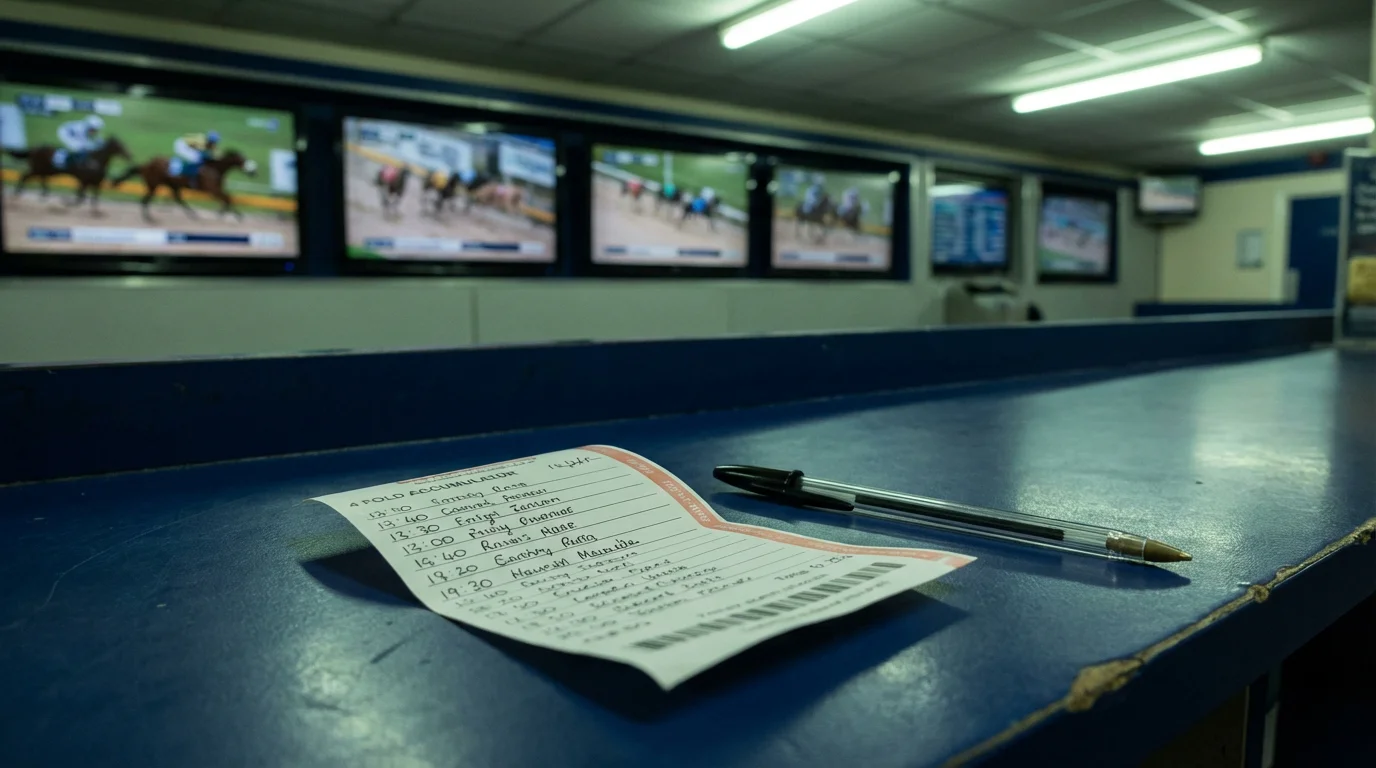
An accumulator — commonly called an acca — links two or more selections across different races into a single bet. The returns from the first winning selection roll into the stake for the second, and so on through the chain. If every leg wins, the cumulative payout can be dramatically larger than any individual win bet. If a single leg loses, the entire bet collapses. That asymmetry — high reward, binary outcome — is what makes accumulators the most popular and the most misunderstood bet type in greyhound racing.
Greyhound accumulators appeal because the sport’s daily volume provides a natural feed of selections. With fifty or more races across a day’s BAGS meetings, it’s easy to find four, five, or six runners you fancy and link them into a single accumulator at a small unit stake. The potential returns look impressive on the slip. The probability of landing all legs, however, is a different calculation — and one that most bettors don’t make before committing the stake.
How Accumulators and Multiples Work
The simplest multiple is a double: two selections in different races. If both win, the payout is calculated by multiplying the two sets of odds together. A 2/1 winner and a 3/1 winner produce a double that pays 11/1 — the original 2/1 returning a trebled stake, which is then multiplied by the 3/1 for the second leg. A £5 double on those two dogs returns £60 (£55 profit plus the £5 stake).
A treble extends this to three selections. Four or more legs constitute an accumulator proper. The payout grows exponentially with each additional leg — a four-fold acca on four dogs at 2/1 each returns at 80/1 — but so does the probability of failure. Each leg that’s added to the chain multiplies the risk. Four independent selections each with a 33% win probability produce an accumulator with a combined probability of roughly 1.2%. In other words, a four-fold acca at 2/1 per leg will land approximately once in every 80 attempts. The 80/1 payout looks like value until you realise the true probability is about 80/1 as well — and the bookmaker’s overround ensures the effective odds are slightly worse than the true probability.
This is the fundamental tension in accumulator betting. The payouts reflect the compounded odds, but the bookmaker’s margin compounds too. On a single bet, the overround costs you a few percentage points. On a four-fold accumulator, that margin is applied four times, and the cumulative drag on expected value is substantial. Over a large sample of accumulator bets, the house edge erodes returns more aggressively than on the same selections placed as individual win bets.
Full-Cover Multiples: Patents, Yankees, and Lucky Bets
Full-cover bets offer a structured alternative to the straight accumulator by including every possible combination of doubles, trebles, and accumulators from a group of selections, plus (in some formats) singles. They cost more per unit but provide partial returns when some legs win and others lose.
The most common full-cover bets used in greyhound racing are:
| Bet Type | Selections | Bets | Includes |
|---|---|---|---|
| Patent | 3 | 7 | 3 singles, 3 doubles, 1 treble |
| Yankee | 4 | 11 | 6 doubles, 4 trebles, 1 four-fold |
| Lucky 15 | 4 | 15 | 4 singles, 6 doubles, 4 trebles, 1 four-fold |
| Lucky 31 | 5 | 31 | 5 singles, 10 doubles, 10 trebles, 5 four-folds, 1 five-fold |
The patent is the entry-level full-cover bet and the most practical for greyhound racing. With three selections, the seven-bet structure means you get a return if even one dog wins (via the singles). If two win, the doubles start paying. If all three win, the treble tops it off. The total stake is seven times your unit — a £1 patent costs £7 — but the protection against total loss makes it more forgiving than a straight treble.
The Lucky 15 is popular because many bookmakers offer bonuses on it: double the odds for a single winner and a consolation payout if all four legs lose. These bonuses improve the expected value compared to the raw mathematical return, though they vary by bookmaker and aren’t always available on greyhound racing specifically. Check the terms before assuming the bonus applies.
Full-cover bets suit greyhound racing when you’ve identified three or four strong selections across different meetings but aren’t confident enough to link them all in a single accumulator. The full-cover structure returns something from partial success — two winners from four, say — whereas the same selections in a straight four-fold return nothing unless all four land. The trade-off is a higher total stake for the same unit size.
Accumulator Strategy for Greyhound Racing
If you’re going to use accumulators, there are a few principles that limit the damage and improve the probability of collecting.
Keep the legs short. Doubles and trebles are the most realistic multiple bets. Beyond three legs, the probability of a clean sweep drops sharply, and the cumulative bookmaker margin works increasingly against you. A four-fold is a speculative punt. A six-fold is a lottery ticket. If the fun of a big payout is the point, keep the stake small and the expectations honest.
Use the same analytical standards for each leg as you would for a single win bet. The temptation with accumulators is to include marginal selections — dogs that “might” win rather than dogs you’d back with full confidence on their own. Each weak leg dilutes the overall quality of the acca. Three strong selections in a treble is a defensible bet. Two strong selections and one thrown in because “it’s the favourite” is a bet with a structural weakness built into the chain.
Avoid correlated legs. Two dogs from the same meeting can’t both win (unless you’re mixing bet types, like a win bet and a forecast, which isn’t a standard accumulator), so that’s physically impossible. But subtler correlations exist: two dogs whose chances both depend on the going being fast, for instance, or two selections at the same track on the same evening where going conditions will affect both races. If the going shifts, both legs are compromised simultaneously. Diversifying across tracks, meetings, and conditions gives each leg more independence — which is the whole point of compounding multiple opinions into one bet.
Consider the patent or Lucky 15 instead of the straight accumulator whenever you have three or four selections. The additional cost is modest relative to the improved probability of a partial return. Over a season of betting, the full-cover approach is more sustainable than the all-or-nothing accumulator, even if the headline payouts are smaller.
When the Chain Breaks
Accumulators are built on a seductive premise: small stakes, big returns. The premise is real — the returns are genuinely large when every leg wins. But every experienced greyhound bettor has a collection of accumulator slips where three of four legs won and the fourth was beaten by a short head at the first bend. The near-misses accumulate faster than the payouts.
The racecard doesn’t change because the bet is a multiple. Each race is still six dogs, one trap, one set of conditions. Your analysis of each leg should be exactly the same whether it’s a single or the third leg of a four-fold. If it isn’t — if you’re cutting corners on analysis because “it’s only one leg of the acca” — the accumulator isn’t amplifying your edge. It’s amplifying your carelessness. Link strong opinions. Keep the chain short. And remember that the most profitable multiple bet you’ll ever place is the one where every leg earned its place on the slip.