Best Greyhound Betting Sites – Bet on Greyhounds in 2026
Loading...
The First Three Seconds Decide More Than You Think
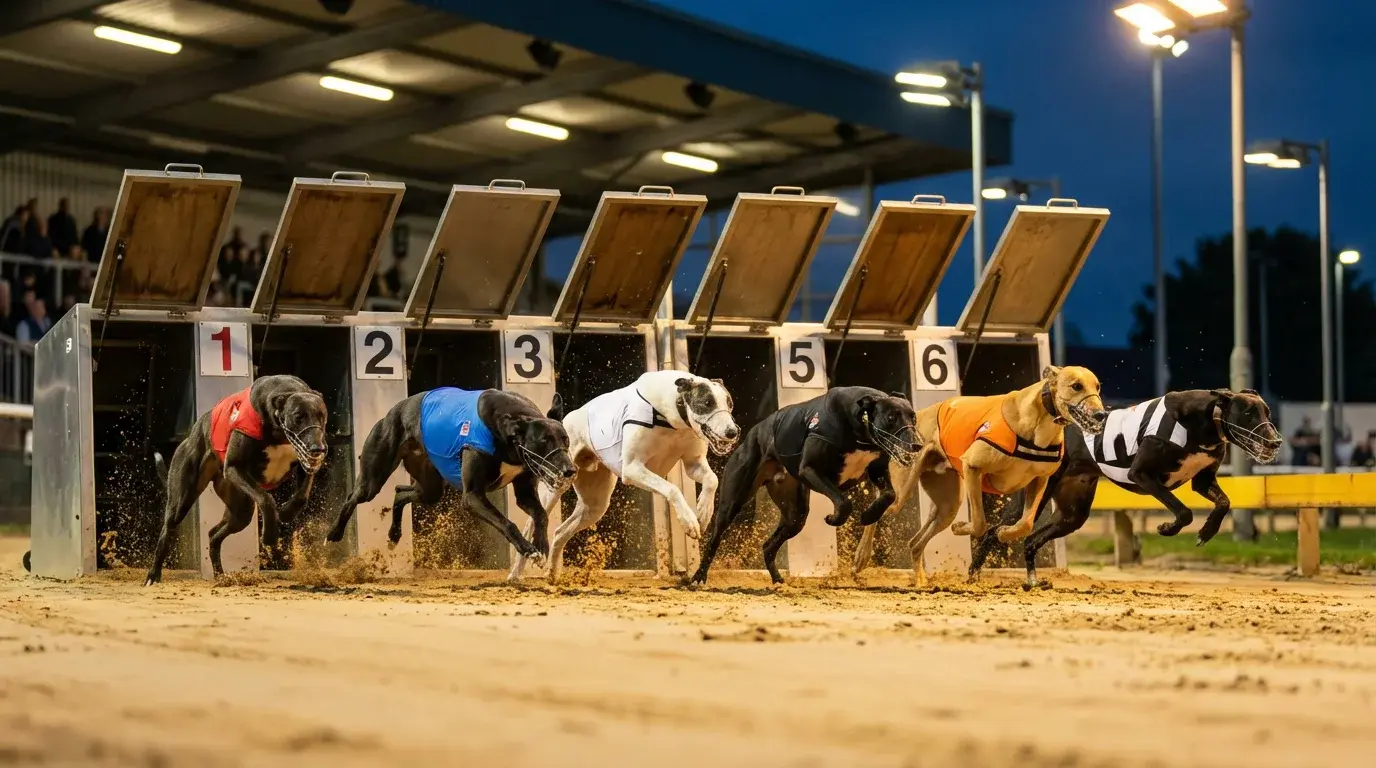
In UK greyhound racing, the dog that reaches the first bend in front wins more often than any other factor would predict. Not the dog with the best finishing speed. Not the dog with the lowest calculated time. The leader at the first bend. This isn’t a marginal tendency — it’s the single most dominant statistical pattern in the sport. Across thousands of races, the first-bend leader converts its position into a win at a rate between 30% and 35%, depending on the track and distance. In a six-runner race, where random chance would give each dog a 16.7% win rate, that’s roughly double the baseline.
Early speed — sometimes called box speed, because it refers to how quickly a dog exits the starting box — is the attribute that produces first-bend leaders. It’s measurable, it’s consistent from run to run, and it’s visible on the racecard through the sectional time column. If you’re not evaluating early speed as part of your racecard analysis, you’re ignoring the most predictive piece of data the card provides.
What Early Speed Is and How to Measure It
Early speed is the rate at which a greyhound accelerates from a standing start in the trap to racing speed. It’s a function of the dog’s physical explosiveness — how quickly it reacts to the lids opening, how fast it reaches full stride — and it’s captured by the sectional time on the racecard.
The sectional time records the interval from the traps opening to the dog crossing the first timing point, typically the finish line on the initial straight before the first bend. In a standard 480m race, this might be a distance of 80-120 metres, depending on the track. The time is expressed in seconds to two decimal places: a fast sectional might be 4.35, a slow one 4.80, with the range depending on the track’s specific measurement point.
What makes early speed so analytically useful is its consistency. Most greyhounds have a characteristic box-speed range that varies by only a few hundredths of a second from run to run. A dog that consistently posts sectionals of 4.40-4.45 is a reliable fast breaker. One that fluctuates between 4.35 and 4.70 is erratic — sometimes first to the bend, sometimes trailing. The consistency of the split, not just its speed, determines how confidently you can predict the dog’s early position.
The racecard makes this easy to assess. Look at the sectional time column across all six previous runs. If five of six splits fall within a tight band — say 4.42 to 4.48 — the dog is a consistent early-pace runner. If the numbers swing by 0.20 seconds or more, the dog’s break is unreliable. Both pieces of information are useful: the first tells you the dog will likely lead; the second tells you it might lead but isn’t bankable for it.
Why First-Bend Position Matters So Much
Greyhound races are run on tight oval tracks with pronounced bends. The first bend is a pinch point where six dogs converge from a spread start into a narrower racing line. The dog that arrives first has first choice of position — typically the inside rail, which is the shortest route through the bend. Every dog behind it has to either settle in behind, go wider, or attempt to challenge for position, all of which cost time and increase the risk of interference.
The physics are unforgiving. A dog that leads into the first bend on the rail takes the shortest path. A dog that’s half a length behind and forced to go wide at the bend travels further — and in a race that lasts less than thirty seconds, that extra distance is rarely recovered. The form remarks confirm this race after race: dogs that lead at the first bend typically show “ALd” (always led), “MadAllOwnRnng” (made all own running), or “SnLd” (soon led) in their comments. Dogs that were caught behind show “Crd1,” “Bmp1,” or “CkBnd1” — crowded, bumped, or checked at the first bend.
This is why early speed is not just one factor among many. It’s the factor that determines whether a dog gets a clean race or a compromised one. A dog with a moderate CalcTm but fast early speed might post competitive results because it consistently avoids trouble. A dog with a superior CalcTm but slow early speed might underperform because it’s perpetually fighting through traffic. The raw ability might favour the second dog. The racing reality often favours the first.
Evaluating Early Speed Across a Field
The most useful application of early-speed analysis is comparative — not asking whether a dog is fast out of the traps in the abstract, but whether it’s faster than the dogs drawn alongside it in today’s race.
Start by listing the average sectional time for each runner over their recent form. Then identify the dog or dogs with the quickest splits. If one dog has a sectional-time advantage of 0.10 seconds or more over the next fastest, it’s the probable first-bend leader. In greyhound terms, 0.10 seconds is roughly one length — enough to reach the bend with clear space and take the racing line it wants.
If two or more dogs have similar fast sectionals, the trap draw becomes the deciding factor. Two fast breakers drawn in traps 1 and 2 will compete for the inside rail in the first few strides. This creates early crowding on the inside, which can benefit a third dog in an outside trap that avoids the traffic. Two fast breakers in traps 1 and 6 are separated by four starting positions — they’re unlikely to interfere with each other, and both may get clear runs on their respective sides of the track.
The interaction between early speed and trap draw is the richest seam of analysis the racecard offers. Map the sectional times onto the trap positions and you can visualise the first three seconds of the race before it happens: which side of the track the pace will be on, where the crowding is likely to occur, and which dogs are positioned to run freely. This isn’t speculation — it’s pattern recognition applied to measurable data, and it works because greyhound racing’s short duration and small field size make the opening phase disproportionately decisive.
When Early Speed Loses
Early speed is the dominant factor, but it’s not an absolute. Dogs that lead at the first bend still lose two-thirds of the time, which means the race has more to it than the opening seconds. Closers — dogs with moderate sectionals but strong finishing pace — win regularly, particularly in races where the early pace is contested and the front-runners tire from battling for position.
Stamina-influenced distances shift the balance slightly. Over 480m at most tracks, early speed is king. Over 600m or longer — stayers’ distances — late pace and stamina carry more weight, and the sectional time becomes one variable among several rather than the primary predictor. The distance of the race, visible on the racecard, tells you how much to weight early speed in your analysis.
There’s also the question of early speed without quality. A dog might break fastest in the field but have the weakest CalcTm. It leads to the first bend, sets a modest pace, and gets picked off by better dogs in the home straight. Leading is an advantage, not a guarantee. The ideal selection combines fast early speed with a competitive CalcTm — a dog that leads and has the ability to sustain its position. When the racecard shows you that combination, especially in a favourable trap, the case for a bet becomes strong. When the early speed comes without the underlying form, the dog is a pacemaker, not a winner.