

Same Betting Slip, Different Sport
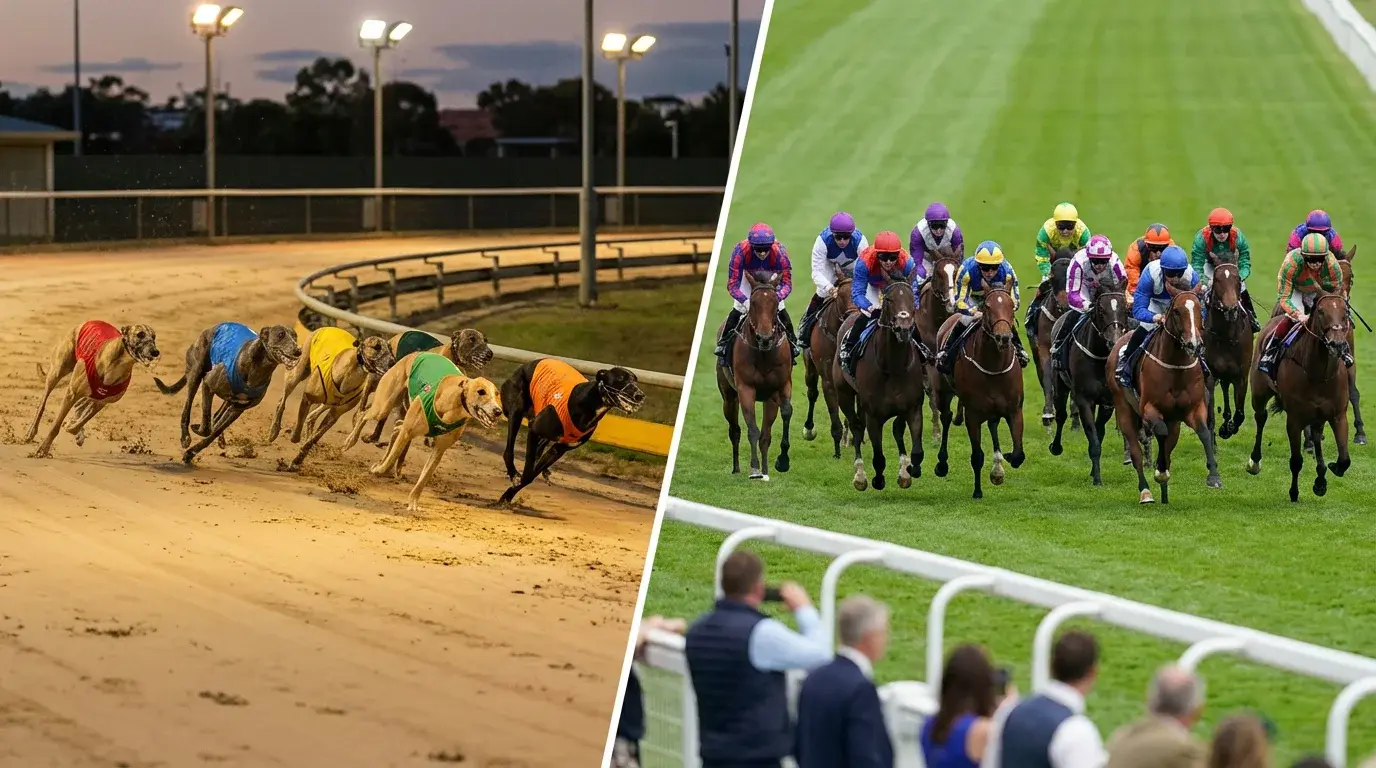
If you’ve come to greyhound racing from horse racing, the surface similarities are reassuring. There’s a racecard. There are form figures. There are odds, a starting price, and bet types you already know — win, each way, forecast, tricast. The bookmaker interface looks the same. The betting mechanics are identical. But the sport underneath is structurally different, and the habits that work well in horse racing can mislead you at the dogs if you don’t adjust your approach.
This guide isn’t a case for one sport over the other. It’s a translation guide for bettors who know how to read a horse racing card and want to understand what changes — and what stays the same — when they turn to greyhounds.
Field Size and Probability
The most immediate difference is field size. UK greyhound races have six runners. Horse races commonly field between eight and twenty, with some handicaps exceeding thirty. This compression changes the probability landscape fundamentally.
In a six-runner greyhound race, a random selection has a 16.7% chance of winning. In a fourteen-runner horse race, it’s 7.1%. The favourite in a greyhound race wins around 30-35% of the time. In horse racing, the favourite’s win rate is typically 30-33% across all race types — a similar figure, but from a much larger field. This means that in greyhound racing, the field is more competitive per runner, and the difference in ability between the favourite and the outsider is typically smaller than in horse racing.
For bettors, this compression means that greyhound favourites are more reliable in absolute terms but offer shorter prices. The odds range in a greyhound race is narrower — you’ll rarely see a 33/1 shot in a six-dog field, whereas they’re routine in horse racing. Forecast and tricast dividends are correspondingly smaller, because the number of possible permutations is vastly reduced. A six-runner tricast has 120 possible combinations. A fourteen-runner tricast has 2,184. The greyhound tricast is more predictable but pays less when it lands.
Form Data and Racecard Depth
Horse racing racecards and greyhound racecards both display previous runs, but the nature of the data differs in important ways.
Horse racing form includes the weight carried, the jockey, the distance, the going, the official rating, and the finishing position in a field that might have included twenty runners. The jockey is a significant variable — different riders produce different results from the same horse, and jockey bookings carry their own form data. Going preferences, distance preferences, and course form are all multi-dimensional factors that require cross-referencing across large datasets.
Greyhound form is simpler in structure but no less rich for a six-runner race. There’s no jockey variable. The dog’s performance is entirely its own. CalcTm provides a direct comparison metric that doesn’t exist in horse racing — there’s no equivalent going-adjusted time that allows you to compare two horses’ ability with the same precision. Sectional times in greyhound racing are standard racecard data; in horse racing, they’re a specialist addition that not all services provide. Trap draw is a fixed physical variable in greyhound racing, whereas the draw in horse racing is relevant only at certain courses and distances.
The result is that greyhound racecard analysis is more compact but more directly comparable. You can rank six dogs by CalcTm, overlay sectional times, check trap draw, and read the remarks in a few minutes. The same depth of analysis on a fourteen-runner handicap would take considerably longer, and the number of interacting variables — weight, jockey, headgear, going preference, trip suitability — is larger. Greyhound form analysis rewards focus and repetition. Horse racing form analysis rewards breadth and contextual knowledge.
Market Structure and Odds
The betting markets for the two sports differ in size, liquidity, and efficiency.
Horse racing markets are deep. Feature races attract millions of pounds in turnover, and the market is shaped by professional gamblers, syndicates, and sophisticated form analysts whose money creates sharp prices. Finding value in a competitive horse race is difficult precisely because the market is so well-informed. The trade-off is that the depth of the market means your bet is unlikely to move the price, and the odds you see are stable and reliable.
Greyhound markets are thinner. Outside of major competitions, the total turnover on a single greyhound race is a fraction of a mid-tier horse race. This means greyhound prices are more volatile — a single large bet can move the market by a full point — and less efficient. The implications are twofold. On the positive side, inefficiencies create value opportunities that don’t exist in deeper horse racing markets. A well-analysed BAGS A6 race might offer a genuine overlay on a dog that the market hasn’t properly assessed. On the negative side, the thin market means that the price you take early might shift dramatically before the off, and the SP might not reflect a balanced market opinion.
The overround — the bookmaker’s built-in margin — tends to be higher in greyhound racing than in horse racing, particularly on BAGS meetings and lower-grade races. A greyhound market might carry a 20-25% overround where a comparable horse race carries 12-18%. This wider margin means the bar for profitable greyhound betting is higher: your selections need to be right more often, or at longer prices, to overcome the house edge.
Race Dynamics and What Decides the Outcome
Horse races unfold over minutes. Greyhound races are over in less than thirty seconds. This time difference changes what matters.
In horse racing, tactics play a significant role. Jockeys make decisions about pace, positioning, and timing that affect the outcome. A horse can be held up, ridden prominently, or delivered late. The run of the race evolves over furlongs, and the jockey’s skill in reading the race is a genuine variable. In greyhound racing, there are no tactics and no rider. The dog runs on instinct, speed, and fitness. The first three seconds — the break from the traps — disproportionately determine the result, because the dog that leads at the first bend avoids the crowding and interference that compromises the dogs behind it.
This makes early speed the single most important factor in greyhound racing, in a way that has no direct parallel in horse racing. Front-running horses win plenty of races, but held-up horses win just as many. In greyhound racing, the first-bend leader wins at a rate that significantly exceeds any other positional advantage. For horse racing bettors moving to greyhounds, recalibrating to weight early speed over finishing ability is the most important analytical adjustment.
Interference is more frequent and more consequential in greyhound racing. Six dogs running at full speed around tight bends with no rider to steer them will bump, crowd, and check each other regularly. The remarks column on a greyhound card carries far more information about in-running incidents than a typical horse racing result. Learning to read those remarks — and to discount form figures that were compromised by interference — is a skill that horse racing bettors need to develop specifically for greyhounds.
Different Sport, Same Principles
The underlying skill is the same: extract information from the racecard, assess probability, identify value in the market, and manage your bankroll. The information is structured differently, the variables are weighted differently, and the race dynamics produce different patterns. But if you can read horse racing form analytically, you can learn to read greyhound form analytically. The adjustment is in the specifics — trap draw instead of jockey bookings, CalcTm instead of official ratings, sectional times as a primary tool instead of a supplementary one.
The biggest trap for horse racing bettors isn’t the sport itself. It’s the assumption that the same instincts transfer without adjustment. They don’t. The racecard looks different because the sport is different. Read it on its own terms, learn its specific patterns, and the analytical framework you’ve built in horse racing becomes a foundation rather than a crutch.
Find more racing guides at greyhoundracingcards.
Also read our virtual greyhound racing.
