Best Greyhound Betting Sites – Bet on Greyhounds in 2026
Loading...
The First Number That Tells the Truth
Every column on a greyhound racecard tells you something about what happened. The sectional time — often labelled “Split” or “Sec” — tells you something about what the dog is actually capable of. It’s the time, in seconds, from the moment the traps open to the moment the greyhound crosses the finish line for the first time, before the first bend on a standard four-bend oval. That makes it a pure measurement of acceleration and raw pace, recorded before any interference, crowding, or tactical running has a chance to distort the picture.
Most bettors glance at the sectional time column without understanding what it reveals. Small fractions of a second here translate to meaningful margins on the track. Over a series of races, a dog that consistently posts fast sectionals is demonstrating early speed — the single most predictive factor in UK greyhound racing outcomes. The dog that leads at the first bend wins more often than any other metric would suggest, and the sectional time is the clearest indicator of which dog is likely to be in that position.
This guide explains what sectional times measure, how to interpret them across different running styles, and why comparing splits between tracks requires care. If you’ve been using calculated times and finishing positions as your primary racecard data, sectional times are the piece you’re probably underweighting.
What Sectional Times Measure
The sectional time — or split time — captures the first phase of a greyhound race: the sprint from the starting traps to the finish line on the initial straight. In a standard four-bend race, this is a straight-line dash before the field enters the first turn. The clock starts when the trap lids open and stops when the dog crosses the line for the first time.
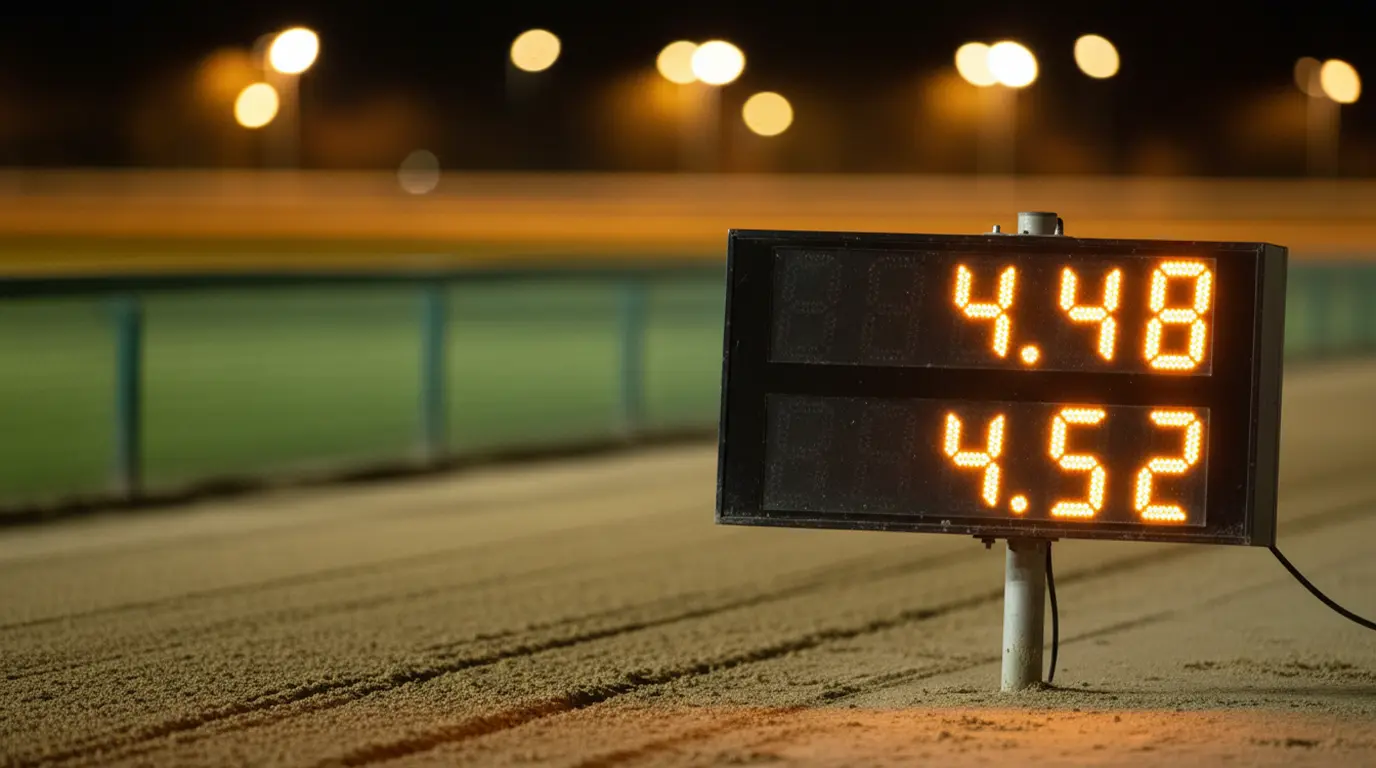
On a typical UK racecard, the split time is expressed in seconds to two decimal places. For a 480m race, sectional times might range from around 4.30 seconds for an exceptionally fast starter down to 5.00 seconds or slower for a dog with a sluggish break. The range depends on the track’s run-up distance — some tracks have longer straights before the first bend, which stretches the sectional times across a wider range and makes the data more granular.
What makes the sectional time uniquely useful is its purity. The finishing time of a race is influenced by everything: going, interference, traffic, the dog’s stamina, and its willingness to compete through the bends. The sectional time strips most of those variables away. It tells you how fast the dog accelerated from a standing start and how quickly it reached top speed. This is a physiological measurement as much as a competitive one — it reflects the dog’s basic speed mechanics rather than the chaos of a six-dog race.
A difference of 0.10 seconds between two dogs’ sectional times at the same track and distance is roughly equivalent to one to one and a half lengths (as Timeform’s ratings guide explains, a length is between 0.07 and 0.08 of a second). So a dog posting a split of 4.45 versus a rival on 4.55 has, in theory, a full length’s advantage before anyone reaches the first bend. In a sport where the winner’s margin is often a neck or a short head, that advantage is enormous. It doesn’t guarantee victory — a fast-breaking dog can still be interfered with or run out of stamina — but it guarantees position, and position at the first bend is the single most valuable asset in a greyhound race.
When reading the racecard, look at each dog’s sectional times across its last six runs. Consistency matters. A dog that posts 4.50, 4.48, 4.52, 4.49, 4.50, 4.51 is a reliable early-speed performer. A dog that fluctuates between 4.40 and 4.70 is inconsistent out of the traps — it might lead or it might be trailing by three lengths before the first bend. The consistent splitter is more bankable, even if its best time is marginally slower than the erratic one’s peak.
Early Pace vs Late Pace: What the Splits Expose
Greyhound racing produces two broad running styles, and the sectional time is the clearest way to identify which type you’re looking at. Front-runners break fast, lead early, and try to maintain that advantage through the bends to the finish. Finishers — sometimes called closers — break moderately or slowly, settle behind the pace, and rely on stamina and bend speed to overhaul the leaders in the final straight.
The sectional time identifies front-runners immediately. A dog that consistently posts the fastest or second-fastest split in its races is an early-pace dog. Its racecard remarks will often include “EP” (early pace), “QAw” (quick away), “SnLd” (soon led), or “ALd” (always led). These dogs derive their competitive advantage from getting to the first bend ahead of the field, which allows them to take the racing line they want — usually the inside rail — without interference. In UK greyhound racing, where the standard race is four bends over around 480m, the dog that leads at the first bend wins approximately 30-35% of all races. No other single variable comes close to that hit rate.
Finishers, by contrast, show moderate or slow sectional times but stronger finishing positions relative to their bend-by-bend progression. You’ll see this pattern in the bend order column: a dog that’s 4th at the first bend, 3rd at the second, 2nd at the third, and wins on the run-in is a closer. Its remarks might include “RnOn” (ran on), “Fin” (finished strongly), or “CmAg” (came again). These dogs often have longer stride patterns and better stamina, and they benefit from races where the early pace is fierce and the front-runners tire.
The betting implication is straightforward but underused. When a race features multiple dogs with fast sectional times, expect early crowding at the first bend. Front-runners drawn alongside each other will compete for position, increasing the chance of interference — and improving the chances of a closer who can stay out of trouble and pick up the pieces. Conversely, when only one dog in the field has notably faster splits than the rest, that dog has a high probability of leading unchallenged to the first bend and dictating the race from the front.
Check the sectional times across the whole field, not just your intended selection. The interaction between six dogs’ splits shapes the race before a single bend is reached. A field where traps 1, 2, and 3 all have fast splits will create chaos on the inside at the first turn. A field where only trap 6 shows real early pace might see the wide runner sweep to the front unopposed. The sectional data, read collectively, gives you a preview of the first three seconds of the race — and in greyhound racing, those seconds often decide everything.
Comparing Splits Across Different Tracks
Raw split times don’t transfer cleanly between tracks. A sectional time of 4.50 at Romford and a sectional time of 4.50 at Towcester are not the same performance, because the two tracks have different run-up distances, different trap configurations, and different timing points.
The distance from the starting traps to the first timing point varies from track to track. A longer run-up produces longer split times even for dogs of identical speed, simply because the clock runs for more metres. Romford’s sprint track, for instance, has a relatively short run to the first bend, which compresses the sectional time range and makes small differences more significant. Towcester’s longer straights produce longer absolute split times but also a wider spread between the fastest and slowest dogs in the field.
This means sectional times are most useful for intra-track comparisons. Comparing a dog’s split time against the field in the same race, or against its own splits over previous runs at the same track and distance, gives you reliable data. Comparing its split time against a dog at a different track gives you almost nothing — the measuring sticks are different lengths.
For bettors who follow racing across multiple tracks, the practical solution is to think in terms of relative speed rather than absolute numbers. Ask whether the dog has the fastest split in today’s field, not whether its split is fast in the abstract. If it posts the quickest sectional in a six-dog A4 at Monmore, it’s the early-pace dog in that race, regardless of what the raw number would mean at Crayford. Track-specific benchmarks — available through services like Timeform, which provide contextualised ratings — can supplement raw splits when you need to evaluate a dog’s ability outside its home circuit.
Dogs that move between tracks are a particular challenge. A greyhound with rapid sectionals at one venue might post slower splits at an unfamiliar track, not because it’s lost speed but because the track geometry or surface doesn’t suit its stride. The first run at a new track is inherently unreliable for split-time analysis. If a dog’s most recent run was at a different venue and the split time looks uncharacteristically slow, check whether that was a debut at the new track before downgrading the dog’s early-speed credentials.
How Split Times Should Shape Your Selections
The sectional time column should be the first filter in your racecard analysis, not the last. Before you look at grades, calculated times, or finishing positions, check the splits. Identify which dog — or dogs — in the field have the fastest early pace. Then ask whether that speed advantage is likely to translate into a first-bend lead given the trap draw and the running styles of the adjacent dogs.
Early speed doesn’t guarantee a winner, but it guarantees a clear run more often than any other attribute. And a clear run is the foundation of a good result. The dogs that suffer interference, get crowded at bends, and finish with “Crd” and “Bmp” in their remarks are overwhelmingly the ones that didn’t secure early position. Speed off the mark is protection against trouble. The split time tells you which dogs have that protection — and which are relying on luck to get a clean passage through the pack.