Best Greyhound Betting Sites – Bet on Greyhounds in 2026
Loading...
Blood Isn’t Form — But It Isn’t Nothing
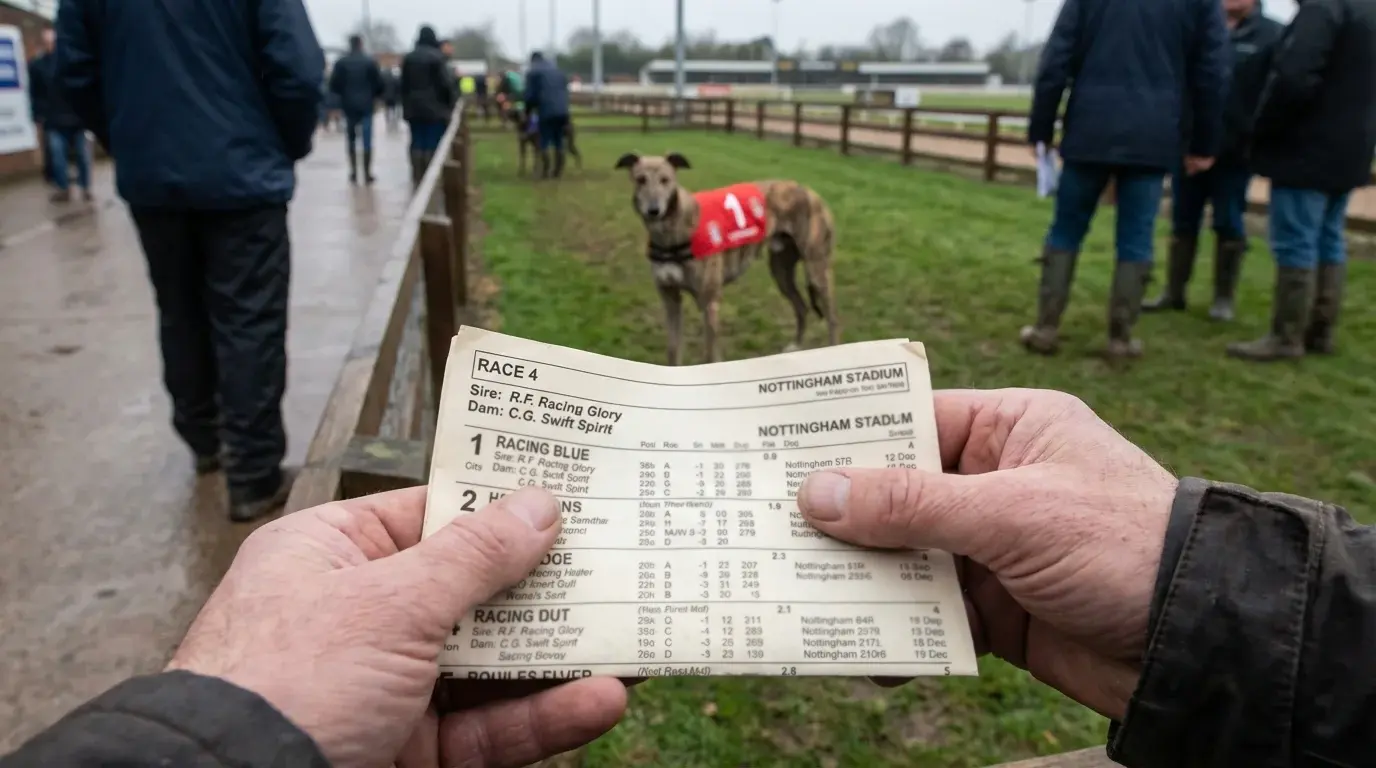
Somewhere on most detailed racecards, usually beneath the dog’s name and trainer, sits a line of parentage data: the sire (father) and dam (mother) of the runner. In horse racing, breeding analysis is an industry in itself — stallion fees run into the thousands, and pedigree shapes market expectations before a horse has run a single stride. In greyhound racing, the relationship between breeding and on-track performance is less commercially dramatic but no less real. Certain sire lines produce sprinters. Others produce stayers. Some bloodlines are associated with early speed, others with stamina, and a few with the kind of unpredictable temperament that makes form reading an exercise in frustration.
For most greyhound bettors, breeding data is a secondary tool at best. CalcTm, sectional times, grade, and remarks provide the primary analytical framework, and those numbers are based on what the dog has actually done, not what its parents did. But in specific situations — maiden races, first runs at a new distance, dogs with limited form — breeding can fill gaps that the form section leaves empty. The question isn’t whether breeding matters. It’s when it matters enough to influence a selection.
What Sire Lines Tell You
In UK greyhound racing, a relatively small number of sires produce a disproportionate share of runners. The gene pool is concentrated, which means certain sire names appear repeatedly across racecards at every track in the country. Over time, patterns emerge in the performance profiles of progeny from specific sires — patterns that are statistically robust enough to inform analysis.
Some sires are associated with early speed. Their offspring tend to break quickly, post fast sectionals, and race prominently from the front. If you see a maiden or lightly raced dog by a known speed sire, the breeding suggests it’s more likely to be a front-runner than a closer — even if it hasn’t yet established a form profile. Other sires produce offspring with stamina. Their progeny tend to improve over longer distances and show their best form at 500m and above, rather than in sprints. A few sire lines are associated with consistency — their offspring post tight CalcTm ranges and rarely produce a wildly out-of-character performance.
The practical challenge is knowing which sires carry which traits. Unlike horse racing, where stallion statistics are published in exhaustive detail by breeding agencies, greyhound sire data is less systematically compiled for public consumption. Services like Greyhound-Data.com provide pedigree information and some offspring performance records. The GBGB’s official database records parentage for all registered greyhounds. But translating sire names into performance predictions requires either accumulated knowledge from watching racing over years or access to data services that aggregate offspring statistics.
For the casual bettor, sire data is most useful as a confirmation tool rather than a primary filter. If your form analysis points to a dog being a likely front-runner — fast sectionals, QAw in recent remarks — and you check the sire and find it’s a known speed producer, the breeding confirms the form. If the form suggests early speed but the sire line is associated with late stamina, there’s a tension worth noting. The form should take precedence — the dog’s actual runs trump its theoretical genetic profile — but the breeding context adds a small degree of confidence in either direction.
Dam Lines and Distance Aptitude
The dam’s influence on a greyhound’s racing ability is at least equal to the sire’s, though it receives less attention. In greyhound breeding, the dam contributes not only genetic material but also the rearing environment — the litter is raised with the dam, and early development conditions vary between breeders and kennels.
Where dam data becomes practically useful is in distance analysis. If a dog is entered at a distance it hasn’t previously raced over — stepping up from 480m to 680m, for example — the dam’s own racing record and her other offspring’s performance at longer distances can indicate whether the family stays or not. A dam that raced successfully at stayer distances, or whose other offspring have won over 600m and beyond, provides a positive signal for distance aptitude. It doesn’t guarantee the dog will handle the trip, but it shifts the probability slightly in that direction.
Sibling form — how the dog’s littermates or half-siblings have performed — is an extension of this analysis. If three siblings from the same dam have all shown a preference for sprint distances, the fourth is probably not a stayer. If the dam’s offspring consistently show early speed regardless of the sire used, the dam is likely transmitting that trait. This kind of analysis requires access to pedigree databases and is more suited to serious form students than casual bettors, but the information exists and is accessible through online greyhound databases.
When Breeding Analysis Has Practical Value
Breeding data earns its place in racecard analysis in a handful of specific scenarios.
Maiden races are the most obvious. Dogs running in maiden company have, by definition, not yet won a graded race at the track. Their form profiles are shallow — sometimes just one or two trials. In the absence of a deep form record, parentage provides a prior estimate of what the dog might do. A maiden by a sire known for producing fast breakers, entered in a sprint, aligns breeding with race conditions. A maiden by a stamina sire entered in a sprint has a less natural fit. Neither observation is decisive, but when the form data is thin, the breeding data is the next-best substitute.
Dogs stepping up or down in distance for the first time also benefit from a breeding check. The form section shows the dog’s record at its previous distance, but it says nothing about whether it’ll handle an extra 200 metres. If the sire and dam both raced over longer distances and the dog’s running style — strong finisher, “RnOn” in recent remarks — suggests it wants further, the step up is well supported by multiple data points. If the breeding is all sprint and the dog fades in the closing stages at 480m, the step up to 680m is unlikely to help.
Beyond these situations, breeding data is supplementary at best. A dog with six runs of solid form at a specific track and distance has told you more about its ability in those six races than its pedigree ever could. The breeding gave it its physical attributes. The form section shows how those attributes perform under racing conditions. By the time a dog has a full form profile, breeding has done its work — it’s embedded in the numbers. Reading the numbers is enough.
Genetics Set the Range — Form Fills It In
Breeding gives a greyhound its speed, its frame, its temperament, and its stamina ceiling. Those are the boundaries of what the dog can do. Form shows you what the dog actually does within those boundaries — on this track, at this distance, from this trap, against this level of competition. For betting purposes, form is the primary evidence and breeding is the background context.
Use parentage data when the form record is too short to be reliable, when a distance change introduces uncertainty, or when you want to cross-check a form-based assessment against the dog’s genetic profile. Outside those moments, the CalcTm column and the remarks section will serve you better than any pedigree analysis. The bloodline got the dog to the track. What it does once the traps open is a matter of record, not inheritance.