Best Greyhound Betting Sites – Bet on Greyhounds in 2026
Loading...
A Kilogram Can Tell a Story
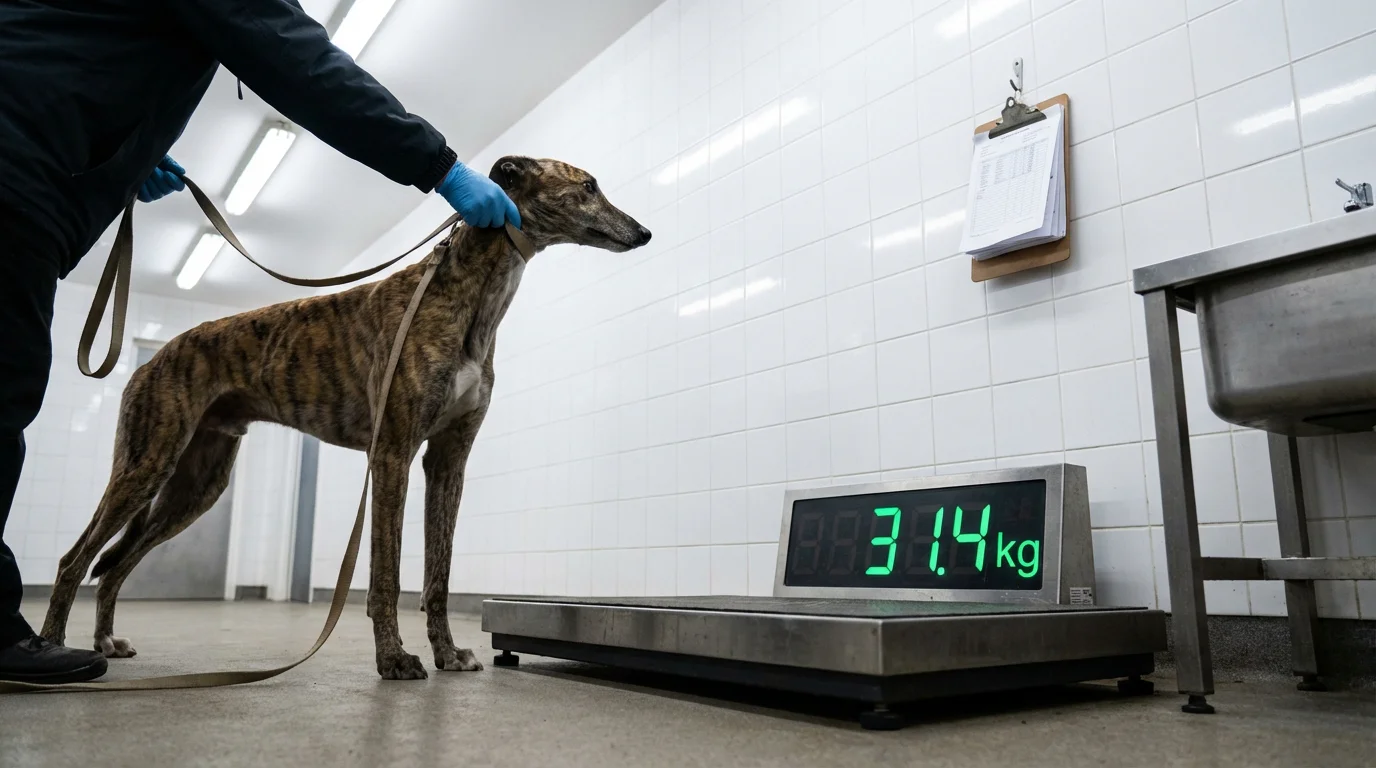
Every greyhound is weighed before it races, and the figure — recorded in kilograms to one decimal place — appears on the racecard alongside each previous run in the form section. Most bettors skip past it. The weight column sits between more attention-grabbing data like CalcTm and SP, and a number like 31.4 doesn’t immediately shout “useful information” the way a fast sectional time does. But weight is one of the few racecard variables that tracks a dog’s physical condition between races, and in a sport where fitness and wellbeing directly affect performance, that’s information worth having.
Weight changes in greyhounds don’t work the same way as they do in horse racing, where a jockey’s weight allowance is a controlled competitive variable. In greyhound racing, the weight is simply a record of the dog’s condition at the time of the race. There’s no weight-for-age system, no handicapping based on bodyweight. But the trend — whether a dog is gaining, losing, or holding steady across its recent runs — can signal changes in fitness, health, or training that the other racecard columns don’t capture.
Normal Weight Ranges and What to Expect
Adult racing greyhounds in the UK typically weigh between 26 kg and 36 kg, with dogs (males) generally heavier than bitches (females). Within this range, each individual greyhound has its own optimal racing weight — the weight at which it performs best — and that weight tends to be remarkably consistent from race to race when the dog is fit and healthy.
A fluctuation of 0.2 to 0.5 kg between consecutive races is normal. Dogs eat, drink, and metabolise at slightly different rates, and the weigh-in happens at a specific moment before the race that may not capture the same hydration or digestion state each time. These minor fluctuations carry no analytical significance. They’re noise in the data, not signal.
Fluctuations above 0.5 kg start to become interesting. A dog that weighed 32.0 in its last race and comes in at 32.8 this week has gained nearly a kilogram. That could indicate reduced training, a deliberate conditioning period, or the early stages of a dog putting on non-racing weight. Conversely, a drop from 32.0 to 31.2 — losing 0.8 kg — might suggest increased training intensity, a change in diet, or a health issue that’s affecting the dog’s condition.
The key is context. A weight change matters most when it departs from the dog’s established range. If a greyhound has raced at 30.8, 30.6, 30.8, 30.7, 31.0 over its last five runs, its baseline is clearly around 30.7 to 31.0. A sudden shift to 31.8 or a drop to 29.9 would be notable — it’s outside the established pattern and suggests something has changed. What that something is requires further investigation, but the weight column has flagged it.
When Weight Gain Is a Signal
Gradual weight gain across several runs can indicate a dog that’s being eased in training — perhaps returning from an injury or being wound down towards retirement. The form figures may still look competitive in the short term, but the upward weight trend suggests the dog isn’t being prepared with the same intensity as before. If the weight gain coincides with gradually slowing CalcTms, the picture becomes clearer: the dog is losing its racing edge.
A sharp weight gain after a break is more ambiguous. Dogs returning from a layoff — visible as a gap in the date column — sometimes come back heavier. This might be natural: the dog has been resting, eating, and not burning the same calories it does during active training. If the first-run-back CalcTm is competitive despite the higher weight, the gain is inconsequential. If the CalcTm is notably slower than pre-break form, the extra weight might be part of the explanation. Expect the dog to sharpen across the next two or three runs as racing fitness returns and the weight drops back towards its baseline.
Bitches in season can show weight fluctuations that aren’t related to fitness or training at all. Hormonal changes affect body composition, and a bitch coming into or out of season may gain weight temporarily. This is a natural cycle, and the weight change in isolation is meaningless — what matters is whether the dog’s CalcTm and running style are consistent with its pre-season form. The racecard doesn’t flag season explicitly, but a female greyhound with an unexplained weight change and a break in racing dates may be returning from a seasonal absence.
When Weight Loss Matters
Weight loss in a racing greyhound that’s running regularly is a more immediate concern than weight gain. Dogs in active training and racing maintain their weight through a balance of exercise and diet. If that balance tips — the dog is stressed, unwell, or overworked — weight drops.
A progressive decline across three or four runs — say from 33.0 to 32.6 to 32.2 to 31.8 — is a trend worth watching. It might indicate overracing: the dog is running too frequently and burning more energy than it’s replacing. Check the date column. If the intervals between races are short — twice a week rather than once — the weight loss may be a consequence of the schedule rather than any underlying issue. If the intervals are normal and the weight is still dropping, something else is at work.
Sharp weight loss — a full kilogram or more between consecutive races — is a red flag. It could indicate illness, a change in kennel conditions, or a dog that’s not eating properly. Trainers and track veterinarians monitor weight closely, and a dog that’s significantly below its normal racing weight may be withdrawn on welfare grounds. From a betting perspective, a dog showing sudden weight loss should be treated with extreme caution regardless of its form figures. The CalcTm might look fine based on recent runs, but if the body behind those times is declining, the numbers are stale.
There’s a useful distinction between weight loss in dogs and bitches. Male greyhounds tend to hold their racing weight more steadily during consistent training, so unexplained drops are more conspicuous. Bitches can fluctuate more naturally due to hormonal cycles, making it harder to isolate a meaningful loss from a normal variation. In both cases, the method is the same: establish the baseline from previous runs, measure the deviation, and cross-reference with the CalcTm and remarks to see whether the physical change has produced a performance change. Note that under GBGB Rule 52, any dog whose weight varies by more than 1.0 kg from its last recorded weight must be withdrawn.
Reading the Weight Column as a Trend
Weight is a background variable. It rarely changes a betting decision on its own. But it adds a physical dimension to the narrative the racecard tells. A dog with improving CalcTms and stable weight is a dog in form and in condition — both signals pointing the same way. A dog with improving CalcTms but declining weight might be sharp now but heading for a plateau as the physical cost catches up. A dog with flat CalcTms and rising weight is coasting — not declining yet, but not being pushed either.
Read the weight column the same way you read any other form variable: across all six runs, looking for direction and consistency. A stable weight supports stable form. A changing weight asks a question that the other columns may or may not answer. And when the weight moves sharply in either direction, pay attention — because the dog’s body is telling you something that its previous CalcTm, set a week or two ago, doesn’t yet reflect.