Best Greyhound Betting Sites – Bet on Greyhounds in 2026
Loading...
Watching the Race Changes How You Read the Card
A racecard tells you what should happen. A live race shows you what actually does. Watching greyhound racing in real time — whether on television, through an online stream, or trackside — adds a dimension to form analysis that printed data alone can’t provide. You see the break, the first-bend congestion, the dog that got bumped but kept running, the closer that was making ground in the final straight. Remarks like “Crd2” and “RnOn” stop being abbreviations and become visible events. Over time, watching races sharpens your ability to interpret the racecard, because you’ve seen what the codes describe.
UK greyhound racing has more broadcast coverage than most bettors realise. Between dedicated racing channels, satellite feeds, and bookmaker live streams, virtually every meeting on the daily fixture list is available to watch. The challenge isn’t access — it’s knowing which platforms carry which meetings and how to match the broadcast schedule to the racecards you’re studying.
Television Coverage: Sky Sports Racing and RPGTV
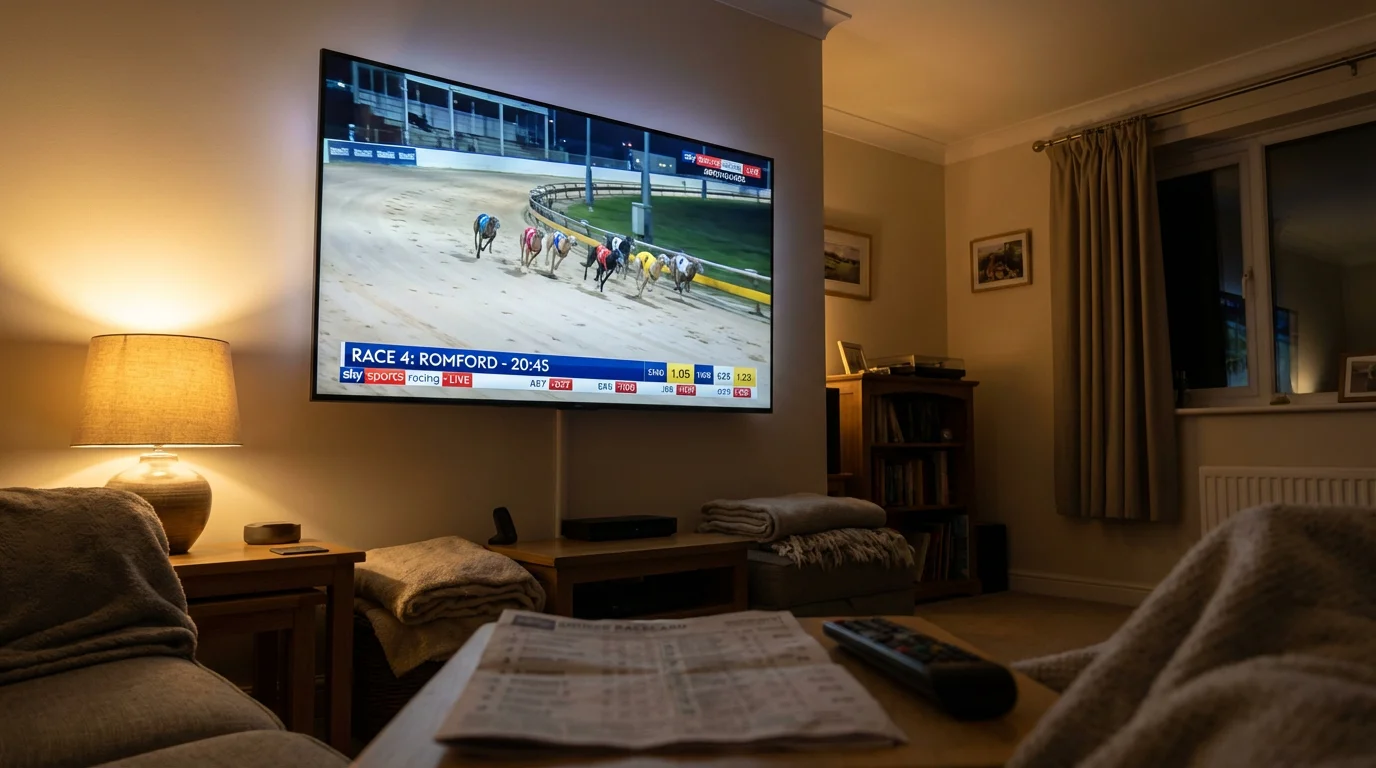
Sky Sports Racing is the UK’s primary television destination for greyhound racing. The channel broadcasts selected evening meetings and feature fixtures, with full race-by-race coverage including pre-race analysis, racecard discussion, and live commentary. Major competitions — the English Greyhound Derby heats and finals, the St Leger, the Cesarewitch, and other Category One events — receive extended coverage with expert panels and build-up programming.
Sky Sports Racing is available as part of Sky TV packages and is also accessible through streaming platforms that carry Sky content. The channel covers both horse and greyhound racing, so the greyhound content sits alongside horse racing broadcasts. The schedule varies — greyhound meetings are typically slotted into the evening programme — and not every evening meeting at every track is televised. Feature meetings at major venues like Romford, Nottingham, and Monmore are most likely to be covered.
RPGTV — Racing Post Greyhound TV — was historically an important broadcast channel for greyhound racing in the UK, offering coverage of BAGS and evening meetings. The channel’s availability and schedule have evolved over the years, and the current state of its broadcasting should be checked via the Racing Post’s own listings, as arrangements with satellite and online platforms have changed periodically.
For bettors who want to watch racing alongside their racecard analysis, the broadcast schedule should be checked against the daily fixture list. Not every televised meeting will align with your racecard selections, but when it does, watching the race live provides real-time information that’s available nowhere else. You see which dogs were unlucky, which had trouble in running, and which won more impressively than the bare result suggests. That visual evidence feeds directly into your assessment of those dogs’ next outings.
SIS and Bookmaker Streaming
The majority of live greyhound racing coverage in the UK is delivered through SIS (Sports Information Services — www.sis.tv), which provides live race feeds to betting shops and online bookmakers. SIS covers virtually the entire BAGS and BEGS fixture list — morning, afternoon, and evening meetings — which means that if a meeting is scheduled and has an active racecard, it’s almost certainly being streamed through SIS-affiliated platforms.
In practice, this means you can watch most live greyhound races through your online bookmaker’s website or app. Major operators — including the major high-street and online firms — embed SIS live streams directly into their greyhound betting interface. Open the page for today’s meetings, select a race, and the live stream is typically available within the same view. You don’t need a separate subscription or a television package. You need an account with a bookmaker that carries the SIS feed, which is most of them.
The quality of bookmaker streams varies. Some platforms offer crisp, full-screen video with minimal delay. Others run smaller embedded streams with a lag of a few seconds between the live action and the displayed picture. For analytical purposes — watching to assess form — the quality is generally sufficient. For live in-play betting, the lag matters, but greyhound races aren’t typically available for in-play markets, so the delay is academic.
Betting shop coverage is the original distribution channel for SIS greyhound feeds. Walk into any licensed betting shop in the UK and you’ll find screens running live greyhound racing throughout the trading day. The presentation is functional — race footage, odds, results — and the atmosphere is a genuine part of the greyhound betting culture. For bettors who prefer to watch racing communally rather than on a laptop screen, the betting shop remains the most accessible venue.
Matching Viewing With Racecard Analysis
Watching live racing is most valuable when it’s focused rather than ambient. Having a stream running in the background while you do other things is entertainment. Watching a specific race because you’ve studied the racecard and want to see how the form translates to the track is analysis.
The ideal workflow runs like this. Study the racecard before the race: check CalcTms, sectional times, trap draw, remarks, and grade. Form a view on how the race should unfold — which dog should lead, where the trouble spots are, which closer might pick up the pieces. Then watch the race. Compare what happened to what you expected. Did the fast breaker lead? Did the middle-trap dog get crowded? Did the closer finish as strongly as its form suggested? The gap between expectation and reality is where you learn, and watching the race is the only way to measure it.
Post-race viewing has analytical value too. Many bookmaker platforms archive recent race replays, and the Racing Post provides video replays for selected meetings. Watching a replay of a dog’s previous race — the one recorded in its most recent form line — can reveal detail that the remarks abbreviations don’t fully capture. “Bmp2” tells you the dog was bumped at the second bend. The replay shows you how severe the bump was, whether the dog recovered quickly or lost momentum for three strides, and whether it was still travelling well before the interference. That granularity isn’t available from the racecard. It’s available from the footage.
Track-specific watching is valuable in its own right. If you regularly bet on a particular venue — Romford, Monmore, Sunderland — watching multiple races at that track across several meetings builds an intuition for its characteristics that no statistics page can fully replicate. You’ll notice which part of the track rides fastest, how the field typically bunches at the first bend, whether inside runners get squeezed on the back straight, and how the camber of the bends affects wide runners. This kind of visual track knowledge, accumulated over time, sharpens every racecard analysis you do for that venue.
The Card Is the Map — the Race Is the Territory
Racecard data is retrospective. It describes what happened in coded, compressed form. Live racing is immediate. It shows you the race as it unfolds, with every detail visible and no abbreviation smoothing over the chaos of six dogs competing at speed. Both are essential. The card gives you the analytical framework to form a pre-race view. The race itself tests that view against the messy reality of competition.
If you bet on greyhounds regularly, make watching races a deliberate part of your process — not every race, but the ones that matter. The ones where your selection runs. The ones where a dog you’re tracking for a future bet is competing. Over weeks and months, the visual library you build from watching racing becomes an analytical tool in itself — a complement to the racecard that no column of numbers can replace.