Best Greyhound Betting Sites – Bet on Greyhounds in 2026
Loading...
The East London Track That Rewards Preparation
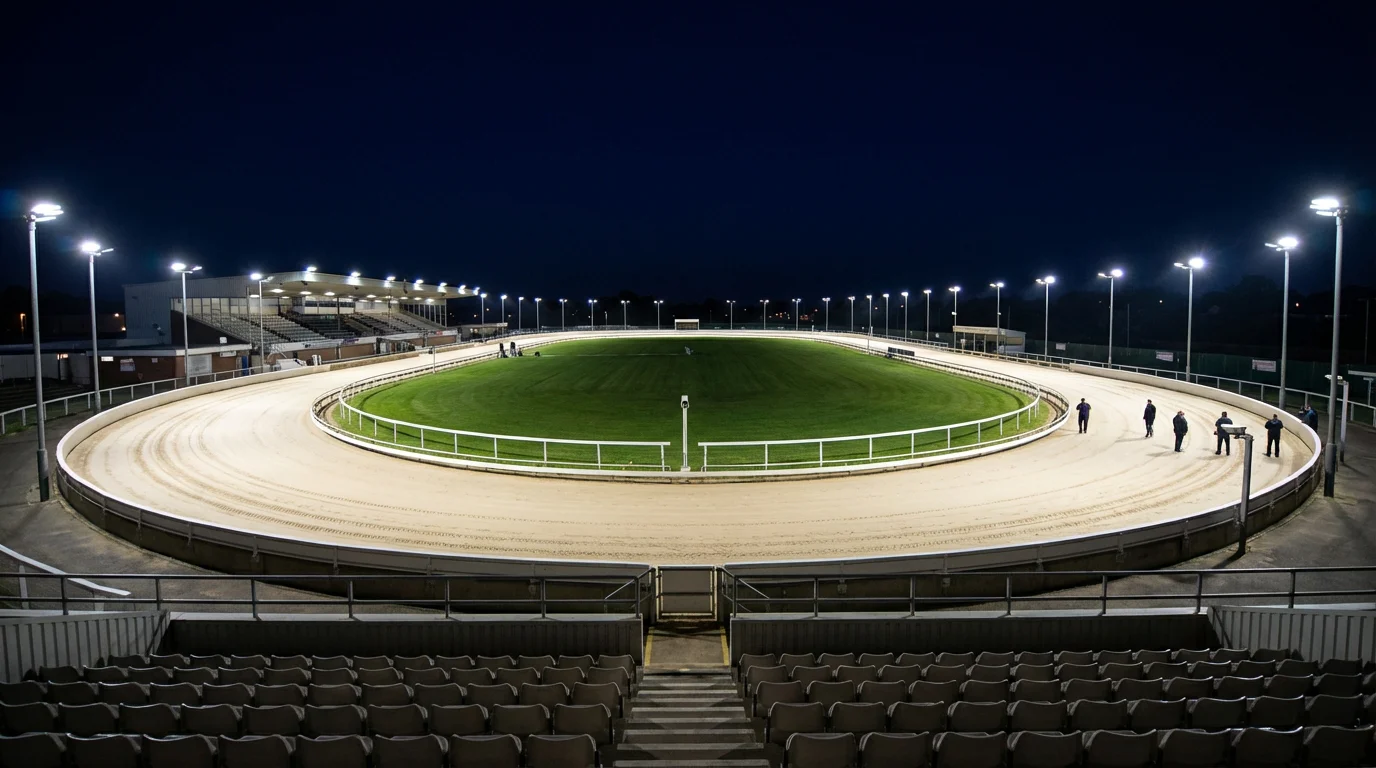
Romford Greyhound Stadium is one of the busiest and most analysed tracks in UK greyhound racing. Located in Romford in the London Borough of Havering, it hosts regular BAGS daytime meetings and open evening fixtures throughout the week, drawing runners from kennels across the south-east and further afield. The track’s compact configuration, its distinctive trap biases, and the quality of its graded racing make it a venue where racecard analysis pays dividends — and where betting without studying the card is notably more expensive than at many other tracks.
If you follow UK greyhound racing with any regularity, you’ll encounter Romford racecards frequently. Understanding the track’s specific characteristics — its distances, its geometry, and the patterns that recur in its results — gives you an analytical edge that generic form reading doesn’t provide. This guide covers what you need to know to read a Romford racecard with track-specific intelligence.
Track Configuration and Distances
Romford is a left-handed oval circuit with a circumference of approximately 350 metres (Greyhound Racing UK). It’s a tight track by UK standards, with pronounced bends and relatively short straights. This geometry amplifies the effect of trap draw and early speed — dogs that secure position at the first bend have a clear advantage through the tight turns, while dogs caught wide or behind traffic lose more ground per bend than they would at a more sweeping circuit.
The principal race distances at Romford are 225m, 400m, and 575m (Greyhound Racing UK). The 400m distance is the most commonly used and accounts for the majority of graded racing at the track. Races over 400m involve four bends, starting on the back straight and finishing on the home straight. The 225m sprint distance is a two-bend dash with a very short run to the first bend — the most trap-biased distance at the venue. The 575m trip is a stayers’ distance that adds an extra half-circuit, rewarding stamina and late pace over raw early speed.
The starting position of the traps varies by distance. At 400m, the boxes are positioned on the back straight with a moderate run-up to the first bend. At 225m, the boxes are set close to the bend, compressing the run-up to a few strides. This positioning is what drives the extreme trap bias at sprint distance — dogs in inside traps reach the bend first simply because they have less ground to cover, and there’s no time for outside runners to compensate.
Trap Bias at Romford
Romford’s trap statistics are among the most clearly defined in UK greyhound racing. The tight left-handed circuit creates a pronounced inside bias, particularly at shorter distances.
At the 225m sprint, trap 1 historically produces the highest win rate — often above 25%, compared to the 16.7% random baseline. Trap 2 also outperforms the average. The middle traps underperform, and trap 6, despite having the widest outside run, doesn’t compensate fully because the sprint distance leaves no time to recover if the outside runner doesn’t break fastest in the field. Sprint racing at Romford is, more than at most tracks, a trap-draw contest.
At 400m, the inside bias persists but is less extreme. Trap 1 still wins at above-average rates, and trap 6 performs better than the middle traps because the longer run to the first bend gives outside runners more time to establish position and the wider arc provides racing room through the bends. Traps 3 and 4 remain the statistically weakest positions, consistent with the first-bend crowding pattern that tighter tracks produce.
At 575m, trap bias dilutes further. The additional distance introduces more racing and more opportunity for form, stamina, and running style to override the starting position. Trap draw still matters — it determines the first-bend dynamics — but the longer race allows dogs that are caught behind early to make up ground through the extra bends and the extended run-in.
For racecard analysis at Romford, the practical rule is: weight trap draw more heavily at shorter distances and give it less emphasis at 575m. At 225m, a dog with a moderate CalcTm in trap 1 may be a better bet than a faster dog in trap 4, purely because the track’s geometry so heavily favours the inside. At 575m, CalcTm and form trajectory carry more weight than the trap number.
Reading Romford Racecards: What to Prioritise
When you open a Romford racecard, three elements deserve extra attention compared to a generic form assessment.
First, sectional times at Romford carry more predictive weight than at most tracks. The tight bends mean that the dog leading at the first bend has a significant advantage through every subsequent turn. Identifying the fastest breaker in the field — cross-referenced with the trap draw — tells you the probable first-bend leader. At 400m, a dog with a sectional-time advantage of 0.05 seconds or more in trap 1 or 2 is a strong proposition. The same advantage from trap 4 is less decisive because the dog has to negotiate traffic before the first bend.
Second, remarks involving crowding and bumping at the first bend (“Crd1,” “Bmp1”) are more common and more consequential at Romford than at tracks with longer runs to the bend. A dog with “Crd1” in three of its last four Romford runs from middle traps is likely to encounter the same problem again from a similar draw. If it switches to an inside or outside trap, the pattern may break. The remarks at Romford aren’t just descriptions of past incidents — they’re structural predictions based on the track’s geometry.
Third, pay attention to dogs with track-specific form. Greyhounds that race regularly at Romford develop familiarity with the bends, the surface, and the specific demands of the circuit. A dog with six consecutive runs at Romford — all at the same distance — has a well-established track record that you can assess with high confidence. A dog arriving from a different track for its first Romford outing is an unknown quantity on this circuit, regardless of how good its form looks elsewhere. The first run at Romford is often a learning experience, particularly for dogs accustomed to wider, more sweeping circuits.
Grading depth at Romford also affects analysis. As one of the busiest tracks in the south-east, Romford has a large pool of registered dogs, which means the grading from A1 down through the lower tiers is genuinely competitive at every level. An A5 at Romford is not the same as an A5 at a smaller track with fewer dogs — the field quality is typically stronger because the grading has more dogs to sort from. When evaluating dogs that have raced at both Romford and smaller venues, their Romford form carries more weight as a measure of ability because the competition they faced was deeper.
A Track That Tells You What It Wants
Romford doesn’t hide its biases. The track statistics are available, the patterns are consistent, and the geometry is transparent. Inside traps win more often at sprint distances. Fast breakers dominate. First-bend position decides a disproportionate share of races. These aren’t secrets — they’re structural features of a compact, left-handed oval.
The edge comes from applying this knowledge systematically to each racecard rather than treating every Romford race as a blank slate. A bettor who checks the trap statistics, prioritises sectional times at this venue, and flags dogs with repeated first-bend trouble from middle draws is working with the track’s grain rather than against it. Romford rewards preparation because its patterns are strong enough to improve your strike rate — provided you build them into your card reading rather than ignoring them.