Best Greyhound Betting Sites – Bet on Greyhounds in 2026
Loading...
- The Racecard Is Your Edge — If You Can Read It
- The Header: Setting the Scene for Every Race
- The Runner Block: Everything About the Dog in One Glance
- The Form Section: Reading a Dog's Last Six Races
- Remarks Column: The Card's Hidden Commentary
- Weight, Starting Price, and Final Details
- Putting It All Together: Your First Card Read
- The Card Never Lies — But It Doesn't Shout Either
The Racecard Is Your Edge — If You Can Read It
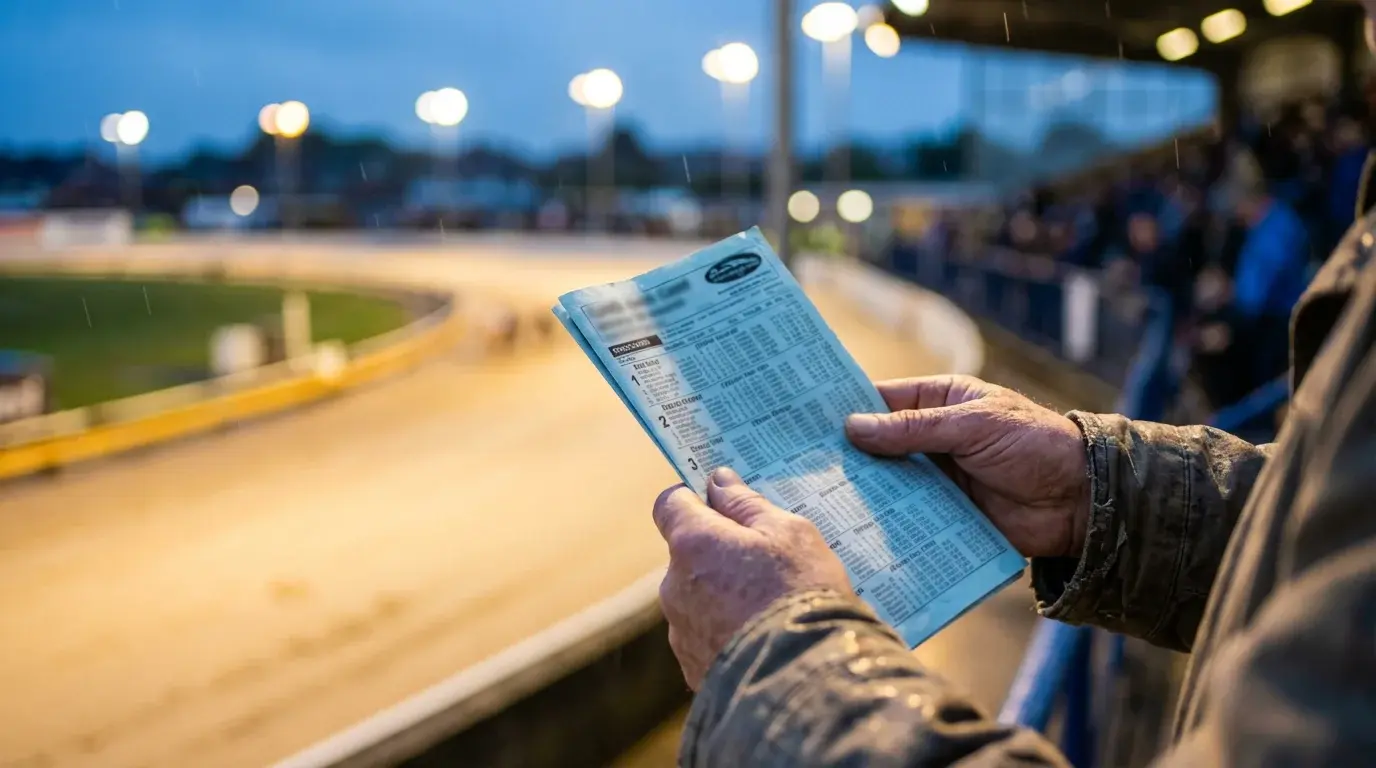
Most people at the dogs pick a name and hope. They glance at the racecard, if they look at it at all, and back whatever sounds fast or lucky or vaguely familiar. That’s not betting — it’s a raffle with worse odds. The racecard is the single most information-dense document in UK sport, and it’s handed to every punter for free. The gap between people who read it and people who don’t is the gap between informed decisions and loose change.
A standard UK greyhound racecard packs more than forty data points per runner into a space no bigger than a few lines of text. Trap draw, form figures, sectional times, calculated times, going adjustments, weight, trainer, breeding, career record, race remarks — it’s all there, compressed into abbreviations and numbers that look impenetrable until you learn the system. And it is a system: a consistent, repeatable structure that every GBGB-licensed track in the country uses.
This guide walks through every element of that structure, section by section, column by column. By the end, you’ll be able to pick up any UK racecard — Romford on a Tuesday afternoon, Towcester on a Saturday night — and extract the information that matters before you place a single bet. No background in greyhound racing required. No assumptions about what you already know. Just the card, explained from top to bottom, so you can read it the way the professionals do.
The Header: Setting the Scene for Every Race
Before you study the dogs, study the race itself. The header block sits at the top of every race on the card and sets the parameters: what kind of contest this is, where it’s being run, and what’s at stake. Every element in the header affects how you interpret the form underneath it.
The first line typically gives you the meeting date and venue. These aren’t just administrative details — the venue tells you which track’s geometry, surface, and going conditions apply, and the date lets you cross-reference recent results. Below that, you’ll see the race number (its position in the meeting’s running order) and the off time — the scheduled start.
The distance appears in metres. UK greyhound racing doesn’t use furlongs or yards: it’s 270m, 400m, 480m, 660m, and so on, with the exact distances varying by track. The distance tells you immediately whether you’re looking at a sprint, a standard race, or a staying event, which in turn tells you what kind of dog is likely to excel. A five-bend 660m race at Monmore is a fundamentally different contest from a two-bend 264m dash at Monmore, even if the card format is identical.
Next to the distance sits the grade. This is the class designation — A1 through A11 at most tracks, plus B, C, D, and open grades — and it’s one of the most important pieces of information on the entire card. The grade tells you the calibre of competition. An A2 race features significantly faster dogs than an A8. A dog’s recent form means nothing without knowing the grade it was achieved in, and a promotion or demotion between races changes the competitive context entirely.
Prize money is listed below the grade, broken down by finishing position — first, second, third, and sometimes fourth. While prize money matters more to trainers and owners than to punters, it’s a useful proxy for race quality. Higher-grade races and feature events carry bigger purses. The BGRF (British Greyhound Racing Fund) contribution, a levy that funds welfare and integrity, is also shown here. It’s a standard deduction, not something that affects your betting, but you’ll see it on every card.
Together, the header tells you: where, when, how far, how competitive, and for how much. That context frames everything that follows in the runner blocks below.
The Runner Block: Everything About the Dog in One Glance
Every runner block is a compressed biography — breeding, experience, and connections packed into two or three lines of data. Once you know the layout, you can absorb the essential profile of a greyhound in seconds.
The block opens with the trap number — 1 through 6 — and the jacket colour that corresponds to it. Trap 1 is red, trap 2 is blue, trap 3 is white, trap 4 is black, trap 5 is orange, and trap 6 is black and white striped. These colours are universal across UK greyhound racing, standardised under GBGB Rule 118. The trap number is more than identification: it determines the dog’s starting position and its proximity to the inside rail, which has a measurable effect on race outcomes.
The greyhound’s name follows the trap number. Below or beside the name, you’ll find the trainer’s name and the owner’s name. Trainer form matters — some trainers consistently produce winners at specific tracks, and knowing who trains a dog gives you access to kennel patterns and strike rates. Owner details are less relevant to betting but complete the picture of the dog’s connections.
The colour and sex line provides a quick physical description. You’ll see abbreviations like “bk d” (black dog, meaning a male), “bd b” (brindle bitch, a female), or “wbk d” (white and black dog). For bitches, the card may note whether the dog is in season — marked as “s” — which can affect performance and is a legitimate factor in your assessment. Dogs marked as in season are sometimes withdrawn, and when they do run, their form can be unpredictable.
The career record appears as a compact string of numbers — typically formatted as something like “42 8-7-5”. The first number is total career starts. The subsequent numbers are first places, second places, and third places. A dog with 42 starts and eight wins has a 19% win rate, which is useful context. A dog with three starts and two wins is unexposed — you have less data, which means more uncertainty. A dog with eighty starts and four wins is reliably slow. The career record doesn’t tell you everything, but it calibrates your expectations before you even look at recent form.
Sire, Dam, and What Breeding Data Signals
Beneath the physical description, the card lists the sire (father) and dam (mother), along with the whelping date (date of birth) and country of origin — typically “Ir” for Ireland or “UK” for British-bred. The whelping date gives you the dog’s age, which matters: most greyhounds peak between two and four years old. A dog under two may still be developing; a dog over four may be declining.
Breeding data is a secondary factor for most bettors, but it’s not meaningless. Certain sires produce offspring with pronounced early speed, while others are associated with stamina and late finishing. If you see a sire whose progeny tend to be strong sprinters and the dog is entered in a staying race, that’s a flag — not a disqualification, but a note worth filing alongside everything else. Serious form students build familiarity with the major bloodlines over time, but for most racecard reading, the practical takeaway is simpler: age and origin. A young Irish-bred dog at a new track may still be adapting. A mature UK-bred with fifty starts at the same venue is a known quantity.
The Form Section: Reading a Dog’s Last Six Races
The form section is where the racecard stops being a programme and starts being a tool. Each runner’s last six races are laid out in chronological rows — most recent at the top — and each row contains a dense sequence of columns that together tell you exactly what happened in that race. Learning to read these columns fluently is the single most valuable skill in greyhound card analysis.
The columns, read left to right on a standard UK racecard, follow a consistent order. Date comes first — the day the race was run. This tells you how recent the form is. A dog whose last run was three days ago is race-fit. A dog whose last entry was six weeks ago has had a break, and you should ask why: injury, rest, or change of trainer.
Next is the distance — the trip in metres for that specific race. This matters because a dog’s form at 480m doesn’t automatically transfer to 270m or 660m. If three of its last six runs were at 480m and today’s race is 480m, that form is directly comparable. If its recent form is over different distances, you need to adjust your assessment.
The trap number for that run is recorded next — the box the dog started from. Comparing past trap draws with today’s draw tells you how the dog has performed from different positions. A dog that won from trap 1 three times but is drawn in trap 6 today faces a different challenge.
Then comes the most telling sequence on the entire card: split time, bend order, and finishing position. These three pieces of data, read together, reconstruct the shape of the race from the dog’s perspective.
Split Times and Bend Order: The Race Within the Race
The split time — sometimes called the sectional time or run-to-bend time — records how quickly the dog reached the first bend. It’s measured in seconds to two decimal places, and it’s the single best indicator of early pace. A dog that consistently posts fast splits is a front-runner: it breaks sharply from the traps and reaches the first bend ahead of the field. A dog with slower splits that still finishes well is a closer — it makes up ground later in the race.
The bend order records the dog’s position at each bend, typically shown as a sequence of numbers. On a standard four-bend race, you might see “1-1-1-1” for a dog that led at every bend, or “5-4-3-2” for a dog that steadily improved its position through the race. This sequence is a miniature narrative: it tells you whether the dog led, tracked, closed, faded, or held its ground. Two dogs can finish in the same position but tell completely different stories through their bend-by-bend progression.
The finishing position and the distance beaten or winning margin complete the picture. A dog that finished second, beaten half a length, after being fifth at the first bend ran a very different race from a dog that finished second after leading for three bends and being caught on the line. The positions alone don’t capture that difference. The bend order and split times do.
Following the positional data, the card shows the name of the winner (and sometimes the second-place finisher), the venue, and the winning time — how fast the race was won. The winning time gives you a raw speed reference, but it’s influenced by going conditions, which is where the next column becomes critical.
Calculated Time and Going: The Adjusted Truth
The going figure reflects the track conditions on the day of that race. In UK greyhound racing, going is expressed as a numerical adjustment — typically shown as a positive or negative value in hundredths of a second. A going figure of +10 means the track was riding slow: times were around 0.10 seconds slower than the track’s standard. A going figure of −5 means the track was fast: times were about 0.05 seconds quicker than normal. This adjustment accounts for sand moisture, temperature, and surface condition.
The calculated time (CalcTm) is the adjusted time for each individual dog’s run, factoring in the going and the distance the dog finished behind (or ahead of) the winner. It’s the most useful time figure on the card because it normalises performance across different conditions. Two dogs might have run at the same track on different days — one on a fast surface, one on a heavy one — and their raw winning times would be misleading to compare directly. Their calculated times strip out the going variable and give you a like-for-like speed comparison.
On many racecards, the best recent calculated time is marked with an asterisk or star. This is the dog’s peak recent performance and serves as a benchmark. When comparing runners in the same race, look at the starred CalcTm figures: the dog with the fastest adjusted time has demonstrated the highest level of raw ability in recent runs. That doesn’t guarantee it will reproduce that time today — but it’s the most reliable starting point for any speed-based comparison.
The CalcTm is more trustworthy than the winning time, the finishing time, or any other raw number on the card. If you only have time to look at one figure per runner, make it this one.
Remarks Column: The Card’s Hidden Commentary
A dog that finished third after being baulked twice didn’t lose — it was stopped. The remarks column is where the racecard tells you things the numbers can’t. Every abbreviated comment describes something that happened during the race that affected the dog’s run, and reading these remarks properly can completely change your interpretation of a result.
Remarks fall into several categories. Start quality codes describe how the dog left the traps. SAw means slow away — the dog was late out of the boxes and lost early ground. QAw means quick away — a sharp break that put the dog in a strong early position. VSAw (very slow away) and MsdBrk (missed break) indicate more serious starting problems. These matter because early pace is the dominant factor in greyhound racing: a dog that finished mid-pack after a slow start might have been positioned to win if it had broken cleanly.
Running position codes tell you where the dog ran on the track. Rls (rails) means the dog hugged the inside. Mid (middle) means it ran in the centre of the track. W (wide) means it raced on the outside. These abbreviations define the dog’s running style and should be cross-referenced with today’s trap draw. A confirmed railer drawn in trap 1 is ideally placed. A confirmed railer drawn in trap 6 has a problem.
Interference codes are the most important remarks for form analysis. Crd (crowded) means the dog was squeezed for room. Bmp followed by a number (Bmp1, Bmp2, Bmp3, Bmp4) indicates the dog was bumped at a specific bend. Blk means baulked — the dog’s run was significantly impeded. FcdW (forced wide) means the dog was pushed off its racing line to the outside. CkBmp (checked and bumped) describes a more severe incident where the dog lost significant momentum. Each of these remarks tells you the dog’s finishing position was worse than its ability that day. A fourth-place finish with Crd3 and Bmp4 in the remarks is not the same as a fourth-place finish with a clear run.
Performance codes describe how the dog ran relative to the race. ALd (always led) means the dog led from start to finish. EvCh (every chance) means the dog had a clear run and every opportunity to win but couldn’t — that’s a form ceiling. RnOn (ran on) means it finished with effort and was closing ground. EP (early pace) notes that the dog showed speed in the early stages. DrewClear means the dog pulled away from the field. These codes help you distinguish between dogs that were beaten by circumstances and dogs that were beaten by ability.
Read the remarks for every run in the last six. A dog with interference in three of its last four races has been unlucky — its true form is better than its results suggest. A dog with EvCh in every run has had every chance and still hasn’t won — it’s probably not good enough at this grade. The remarks column is the card’s editorial voice, and ignoring it means reading only half the story.
Weight, Starting Price, and Final Details
The final columns on each form line record the dog’s weight in kilos, the starting price (SP), and the grade of that particular race. These are the details that round out the picture — and in certain situations, they’re the details that matter most.
Weight is recorded to one decimal place. A typical racing greyhound weighs between 26kg and 36kg, depending on build and sex. What you’re looking for isn’t the absolute number but the trend. A dog that weighed 32.5kg three runs ago, 32.0kg two runs ago, and 31.4kg last time is losing weight — which could indicate a health issue, insufficient recovery between races, or a change in condition. Conversely, a dog putting on weight after a break might be coming back fresh and well-fed. Stable weight across several runs is the baseline you want to see: it suggests the dog is in consistent physical condition. Fluctuations of more than a kilo between consecutive runs deserve attention.
The starting price for each past race shows what odds the dog went off at. This tells you how the market assessed the dog on that day. A dog that started at 2/1 and won was the second favourite and delivered. A dog that started at 8/1 and won was largely overlooked by the market — either a genuine surprise or a sign that the form wasn’t being read properly. Tracking the SP history across six runs can reveal whether a dog is consistently overbet (short prices, frequent losses) or undervalued (longer prices, competitive finishes).
The grade column in the form line records the class of race the dog competed in for each past run. This is essential context. A dog that finished third in an A2 three weeks ago and is now running in an A5 has dropped in class — that third-place finish against stronger opposition might translate to a winning performance today. Without checking the grade column, you’d just see “third place” and miss the significance entirely.
Weight, SP, and grade are the final data points on the card, and sometimes the first things that change your mind about a selection. A dog with strong form at a higher grade, stable weight, and a drifting SP that suggests the market hasn’t noticed the class drop — that’s exactly the kind of opportunity the racecard was designed to reveal.
Putting It All Together: Your First Card Read
Now take what you’ve learned and read this card like it’s your money on the line. Here’s a walkthrough of a hypothetical six-runner race — a standard A5 graded event over 480m — showing how to apply each element of the card to narrow the field and form a view.
Start with the header. The race is 480m, A5 grade, at an evening meeting. That tells you it’s a standard four-bend trip at a mid-range grade — expect competitive dogs with a mix of running styles. No staying specialists needed, no pure sprinters favoured.
Move to the runner blocks. Scan the trap draws and career records first. Trap 1 has a dog with 56 starts and 11 wins — experienced and moderately successful. Trap 3 has a dog with 12 starts and 4 wins — less exposed but a higher win rate. Trap 6 has a dog with 80 starts and 5 wins — it’s been around a long time without winning much. Already, you’re building a rough hierarchy: the younger, sharper dog in trap 3 looks interesting; the older dog in trap 6 looks like a perennial also-ran.
Now go to the form. Read each dog’s last six runs, focusing on four things: calculated time (who’s the fastest?), split times (who gets to the first bend earliest?), remarks (who’s been unlucky?), and grade (who’s been competing at a higher level?).
Suppose the trap 1 dog has the fastest CalcTm in the race — a starred 29.45 — but its last three remarks show Crd2 and FcdW repeatedly. It’s fast, but it keeps running into trouble. That’s a dog with ability that the results don’t fully reflect. Trap 3 has a CalcTm of 29.60, no interference in recent runs, and QAw in four of its last six starts. It’s slightly slower on paper but gets clean runs and breaks sharply. Trap 4 has been running in A3 for the last month and was recently dropped to A5 — its CalcTm of 29.52 was achieved against tougher opposition. That’s a class drop with speed. Trap 6’s CalcTm is 30.10, the slowest in the field by a margin. You can effectively eliminate it.
Check the weight column. The trap 4 dog has been stable at 33.1kg across all six runs — consistent condition. The trap 1 dog has dropped from 31.8 to 30.9 over three runs — a kilo of weight loss that warrants caution. The trap 3 dog is steady at 28.5kg.
Now synthesise. You have three genuine contenders: trap 1 (fastest CalcTm but trouble-prone and losing weight), trap 3 (sharp starter, clean runs, slightly slower), and trap 4 (class drop, solid speed, stable weight). The form section told you who’s fast. The remarks told you who’s been unlucky. The grade column told you who’s dropping in class. The weight column flagged a concern. No single column gave you the answer — but reading them together gave you a clear shortlist and a justified opinion.
That process — header, runners, form, remarks, weight, grade — is the same for every race on every card. The more often you do it, the faster it becomes. Within a few weeks of practice, you’ll scan a six-dog racecard in five minutes and form a view that would have taken an hour when you started.
The Card Never Lies — But It Doesn’t Shout Either
The information is there. It always was. The racecard doesn’t hide anything — it just doesn’t explain itself. Every number, every abbreviation, every column has a purpose, and once you understand the structure, the card becomes the most honest document in betting. It tells you what happened, when it happened, and under what conditions. It tells you how fast a dog ran, where it ran, and what got in its way. It doesn’t embellish and it doesn’t omit.
What separates a racecard reader from a racecard glancer is time and repetition. The first card you read will take twenty minutes and leave you uncertain. The fiftieth will take five minutes and leave you with a firm opinion. The skill isn’t innate — it’s built through practice, the same way you’d learn any other analytical discipline. Each race you study adds to your internal library of patterns: how fast CalcTms translate across grades, what it means when a dog shows EP but fades, how a trap 1 draw changes the dynamic for a confirmed railer.
There is no shortcut, and there doesn’t need to be one. The racecard is designed to give you everything you need. The only question is whether you’ll take the time to read it properly before the money goes down. If you’ve made it this far, you already know the answer.