Best Greyhound Betting Sites – Bet on Greyhounds in 2026
Loading...
- Your Track, Your Card, Your Race
- All Licensed UK Greyhound Tracks
- Track Distances and What They Mean for Form
- BAGS, BEGS, and Open Racing: What's the Difference?
- Understanding the UK Greyhound Racing Schedule
- Track Bias and How It Affects Your Card Analysis
- Specialising: Why Backing Dogs at Tracks You Know Wins
- No Two Tracks Run the Same Race
Your Track, Your Card, Your Race
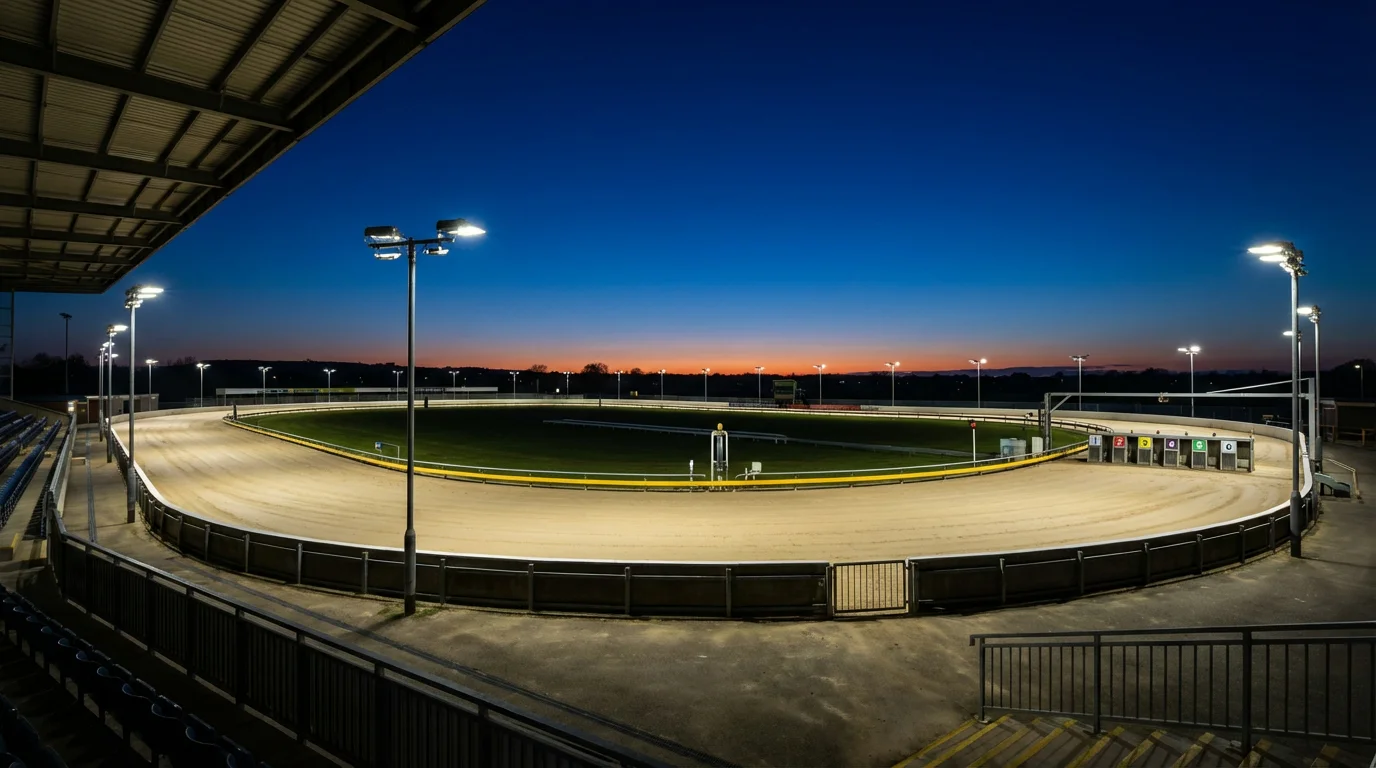
Greyhound racing isn’t one sport — it’s twenty-plus variations on the same oval. The UK has 18 licensed greyhound stadia operating under GBGB regulations, and each one has its own personality: different distances, different trap-to-bend distances, different bend radii, different surface characteristics, and different grading populations. A racecard at Romford doesn’t read the same way as a racecard at Towcester, even though the format is identical, because the track beneath the data is fundamentally different.
For punters, this means that track knowledge is a genuine edge. The going figures, the calculated times, the trap statistics, the grade standards — all of these are track-specific. A CalcTm of 29.50 at one circuit is not the same as 29.50 at another. A trap 1 advantage that holds at a tight-bended track may evaporate at a wider circuit. Understanding what each UK track offers, and how its characteristics affect the data on the card, is one of the most underrated skills in greyhound betting.
This guide covers every licensed UK track, the distances they race over, how the fixture schedule works, and why track-specific analysis matters for anyone serious about reading cards and placing bets.
All Licensed UK Greyhound Tracks
Know the track before you read the card. The following profiles cover the GBGB-licensed tracks operating in the UK, grouped by region. Each entry notes the key distances, typical meeting schedule, and any distinctive features that affect how racecard data should be interpreted. Track rosters evolve — venues occasionally close or lose their licence — so check the GBGB website for the current list of active tracks.
London and South East
Romford is one of the busiest tracks in the UK, running both BAGS afternoon meetings and open evening cards. Standard distances include 225m, 400m, and 575m. The circuit is tight with a short run from the traps to the first bend, which amplifies the inside-trap advantage. Romford produces some of the deepest betting markets of any UK track, and its large racing population means the grading structure is particularly competitive — an A5 at Romford may be tougher than an A5 at a smaller circuit.
Central Park (Sittingbourne) operates primarily as a BAGS venue with distances including 265m, 380m, and 540m. It’s a smaller track with a more modest racing population, which means the grading structure is less deep — form can be thinner to read, but the market inefficiencies can be larger.
Midlands and East
Monmore Green (Wolverhampton) is a prominent Midlands track with distances of 264m, 480m, 630m, and 684m. It hosts a mix of BAGS and open meetings, including feature competitions. The 480m standard trip is one of the most commonly raced distances in the UK, and Monmore’s grading population is large enough to produce well-contested races across the spectrum.
Dunstall Park (Wolverhampton) is the newest GBGB-licensed track, opened in September 2025 within the existing Wolverhampton Racecourse. It replaced Perry Barr (Birmingham), which closed after nearly a century. Dunstall Park hosts Category 1 and Category 2 events, including the Premier Greyhound Racing Oaks and St Leger, and attracts top-grade dogs from across the country.
Nottingham operates with standard distances including 305m, 480m, and 500m. It’s a steady BAGS circuit with consistent going conditions and a well-established grading system. The trap-to-bend distance suits middle-draw runners more than some tighter tracks.
Yarmouth runs over 277m, 462m, and 659m. It’s a smaller venue in the east of England, primarily serving the BAGS schedule. The 462m standard distance is slightly shorter than the 480m used at many other tracks, which affects CalcTm comparisons if you’re crossing form between venues.
Henlow offers distances of 277m, 450m, 550m, and 727m, making it one of the more distance-diverse tracks in the country. The marathon trip at 727m attracts specialist stayers and produces distinctive form that doesn’t always transfer to shorter-distance venues.
North and Scotland
Sheffield is the major track in the north of England, running over 280m, 460m, 500m, and 660m. It hosts high-quality evening meetings alongside BAGS fixtures and is a regular venue for significant open races. The 500m trip provides an additional middle-distance option that some other tracks don’t offer, and form students should note whether a dog’s record is at 460m or 500m — the two distances reward subtly different profiles.
Sunderland runs over 268m, 450m, and 640m. As the main north-east venue, it has a dedicated pool of regular runners and consistent going data. The 450m standard distance is shorter than the UK average, which can benefit pure-speed dogs over those that need a longer trip to show their stamina.
Newcastle (Byker) operates with distances including 290m, 480m, and 640m. It runs a regular BAGS and evening schedule and, like other northern tracks, can experience heavier going conditions during winter months due to regional weather patterns.
Kinsley runs over 277m, 462m, and 647m. It’s a smaller Yorkshire track that predominantly serves the BAGS circuit. The roster of regular runners is modest, meaning grading can be less competitive than at the major venues — something to account for when reading form from dogs transferring to or from Kinsley.
Track Distances and What They Mean for Form
A 29.50 CalcTm at Romford and a 29.50 at Towcester are two entirely different runs. UK greyhound track distances are not standardised — every circuit has its own set of trips, and even distances that share the same nominal label can vary in their actual characteristics because of differences in trap position, bend geometry, and straight length.
Distances fall into broad categories. Sprint races run from around 225m to 300m, involving two bends or fewer. These are pure speed tests where trap draw and early pace dominate. Standard or middle distances cover roughly 380m to 500m, the four-bend trips that make up the bulk of UK racing. This is where the broadest form data exists and where grading is most competitive. Staying races start at around 550m and extend to 660m or beyond. Marathon races — 700m and above — are rare and attract specialist stayers with a completely different physical profile.
The critical point for racecard analysis is that CalcTm comparisons are only meaningful at the same distance and, ideally, the same track. A dog that posts a CalcTm of 29.50 over 480m at Monmore has run a different race from a dog that posts the same figure over 462m at Yarmouth. The track geometry, the number of bends, and the sand surface all influence what that time represents in terms of actual ability. When you’re comparing runners in an upcoming race, focus on their CalcTm figures at the distance and track where today’s race is being run. Form from other distances or other venues is useful context, but it’s not a direct comparison.
Distance aptitude is also individual to each dog. Some greyhounds are natural sprinters — explosive from the traps, fast through two bends, but unable to sustain their effort over four. Others need the extra distance to show their stamina and closing speed. The racecard tells you which distances a dog has previously raced over and how it performed at each. If a dog’s form is exclusively over 480m and it’s entered in a 270m sprint, that’s an unknown. Treat it accordingly.
Form at the same track and the same distance is the gold standard. Everything else requires adjustment. The further you move from that baseline — different track, different distance, different going — the less reliable the comparison becomes. When a dog arrives at a new track after a transfer, its first one or two runs should be treated as orientation: the times may not reflect its true ability until it’s adjusted to the circuit. Watch for NTrk (new track) in the remarks column, which flags exactly this situation.
BAGS, BEGS, and Open Racing: What’s the Difference?
BAGS races run for the betting shops. Open races run for the trophies. That’s the simplest distinction, and it matters for how you read the card.
BAGS — Bookmakers Afternoon Greyhound Service — provides the fixtures that keep greyhound racing content flowing through betting shops and online bookmakers during the afternoon. These are graded races scheduled primarily for the benefit of off-course betting: the dogs, trainers, and prize money are real, but the meetings exist because the betting market needs product. BAGS meetings run from late morning through the afternoon, with races every ten to fifteen minutes across multiple tracks simultaneously.
BEGS — Bookmakers Evening Greyhound Service — is the evening equivalent. These meetings serve the same function as BAGS but run in the early to mid-evening, overlapping with the end of the afternoon schedule and the start of the premium racing programme.
Open racing sits at the top of the quality pyramid. Open meetings are typically evening or Saturday events featuring higher-grade races, feature competitions, and Category 1 or Category 2 events. The fields are stronger, the prize money is higher, and the racing is often televised or streamed more prominently. Open-race cards attract the best dogs at a track, and the form from these events is generally the most reliable indicator of a greyhound’s true class.
The distinction matters for card reading because the quality of opposition varies across these categories. A dog that wins an A5 on a BAGS afternoon card is beating a different calibre of field from a dog that wins an A5 at a Saturday open meeting — even though the grade label is the same. When comparing form across meetings, note whether the runs were at BAGS, BEGS, or open fixtures. Dogs that perform well at open meetings are typically sharper, and their form translates more reliably to other competitive contexts.
Understanding the UK Greyhound Racing Schedule
On a busy weekday, there are ten or more meetings running across the country — cards from morning to night, every fifteen minutes, at tracks from Glasgow to Sittingbourne. The UK greyhound fixture schedule is one of the densest in professional sport, and understanding its structure helps you decide where to focus your card analysis rather than trying to cover everything.
The daily pattern follows a predictable sequence. Morning BAGS meetings start from around 10:00 AM, typically at two or three tracks. Afternoon BAGS meetings run from roughly midday to 5:00 PM, with the heaviest concentration of fixtures — four to six tracks often racing simultaneously. Evening meetings begin from 6:00 PM or 7:00 PM, with a mix of BEGS fixtures and open racing at the major venues. Saturday evenings tend to carry the highest-quality open meetings.
The fixture list is published by the GBGB and reproduced by data providers like Timeform and the Racing Post. These services list every scheduled meeting with off times, distances, and racecard availability. Most bookmakers also publish a running schedule showing all upcoming races, which is the quickest way to see what’s on at any given moment.
Seasonal patterns affect the schedule. Summer months tend to have more evening meetings, taking advantage of longer daylight and warmer conditions. Winter can see more cancellations due to weather — frozen or waterlogged sand surfaces occasionally force meetings to be abandoned. The Christmas and New Year period traditionally features a packed schedule with feature events and high-quality open meetings.
For punters, the practical question is coverage. Trying to study racecards across eight simultaneous afternoon meetings is impractical and leads to thin analysis. The better approach is to identify two or three meetings where your track knowledge is strongest, study those cards thoroughly, and let the rest pass. Depth of analysis at fewer meetings consistently outperforms shallow analysis across many.
Track Bias and How It Affects Your Card Analysis
Track bias is invisible on the racecard — but it determines half the result. Every greyhound track has a geometry, and that geometry creates systematic advantages for certain trap positions, running styles, and dog profiles. The racecard doesn’t print “trap 1 wins 23% of races here” at the top of the page, but the data exists — and the punters who know it have a persistent edge over those who don’t.
The primary source of bias is the run from the traps to the first bend. At tracks where this distance is short, inside traps have an amplified advantage because the field converges on the rail before dogs have fully reached their stride. Outside-drawn dogs arrive at the bend later, wider, and in more traffic. At tracks with a longer run to the first bend, the bias flattens: dogs have more time to find their position, and wide runners can stride out before needing to negotiate the turn.
Bend radius is the second factor. Tight bends magnify the inside line’s ground-saving advantage. On every bend, the dog on the rail covers less distance than the dog running wide — and over four bends, the cumulative difference can amount to several metres. At tracks with wider, more sweeping bends, the difference is smaller, and wide runners lose less ground per turn.
Trap statistics for individual tracks are published by data services like Timeform and are available on some bookmaker platforms. These numbers show the win percentage for each trap position at each distance, and they’re the most direct measure of track bias available. A track where trap 1 wins 22% of all 480m races has a strong inside bias. A track where the trap wins are evenly distributed at 15–18% across all positions is relatively neutral.
The practical application is layering trap statistics onto your card analysis. When two dogs are closely matched on form, CalcTm, and class, check the trap data for the track and distance. If one dog is drawn in the statistically favoured position, that’s a meaningful tiebreaker — not because the trap guarantees anything, but because the geometry of the track gives it a structural advantage that shows up consistently across thousands of races.
Specialising: Why Backing Dogs at Tracks You Know Wins
The punter who knows Romford inside-out will beat the one who bets everywhere. Specialisation is the most practical edge available to a greyhound bettor because it compounds over time in ways that general knowledge doesn’t.
When you focus on two or three tracks, you learn things that no racecard can teach you. You learn which trainers consistently produce winners at that venue. You learn how the going typically varies between summer and winter. You learn which dogs are regulars and how their form tends to cycle. You learn the trap bias from experience, not just statistics — you’ve watched enough races to see how the geometry plays out in real time. That accumulated knowledge creates an informational advantage over the market, which prices runners based on headline form data without the track-specific context you’ve built.
The case for specialisation is also a case against overextension. Studying twelve simultaneous meetings at tracks you barely know produces twelve surface-level assessments. Studying two meetings at tracks you know well produces two deep, informed assessments. The maths of profitable betting favours precision over volume. You don’t need to bet on twenty races a day. You need to bet on three or four races where your analysis is genuinely stronger than the market’s. Track specialisation is how you get there.
No Two Tracks Run the Same Race
Tracks don’t just host races — they shape them. The sand at Monmore rides differently from the sand at Towcester. The first bend at Romford catches different dogs than the first bend at Sheffield. The grading population at Dunstall Park produces a different competitive context from the grading population at Kinsley. Every track-specific variable filters through the racecard and into the numbers you’re reading — the CalcTm, the split times, the going adjustment, the trap results. The data is the data, but the track is the lens.
Learning the UK track map takes time. You won’t memorise twenty venue profiles in a week, and you don’t need to. Start with the tracks where you bet most, learn their distances and biases, watch their races, and build your knowledge outward from there. The racecard gives you the framework. The track gives it meaning.